Manganese, Iron, and a Warm White Field
Calacatta Viola comes from the same Apuan Alps geological story as Carrara White, Calacatta Gold, and Statuario. The base material is the same Jurassic limestone metamorphosed into marble. What separates Calacatta Viola is the trace mineralisation. Where Calacatta Gold's veining comes from oxidised iron, Calacatta Viola's veining picks up traces of manganese oxide alongside the iron, which produces the characteristic purple-to-violet pigmentation in the deeper veins. The combination of manganese and iron in different concentrations across the slab gives the stone its painterly character: some veins read warm grey, some read deep violet, some read closer to charcoal.
The active Calacatta Viola quarries cluster in the upper hills above Carrara, primarily in the Vagli area. Production is intentionally limited; the stone is treated as a premium varietal rather than a commodity grade. Slab availability fluctuates significantly with market demand, and during the peak of the trend in 2021-2023 wait times for premium Viola grades stretched to nine months. Supply has caught up somewhat in 2025-2026, but the stone remains a special-order specification rather than a stocked commodity at most North American suppliers.
- Original rock: Limestone (sedimentary) from the Jurassic period, ~190M years old
- Metamorphism: Apennine orogeny pressure and heat, ~30M years ago
- Veining minerals: Manganese oxide (the violet) and iron oxide (the warm grey), deposited along bedding planes
- Sister stones: Calacatta Gold, Carrara White, Calacatta Borghini
- Hardness: Mohs 3-4
- Slab variation: Significant; each block has distinct character
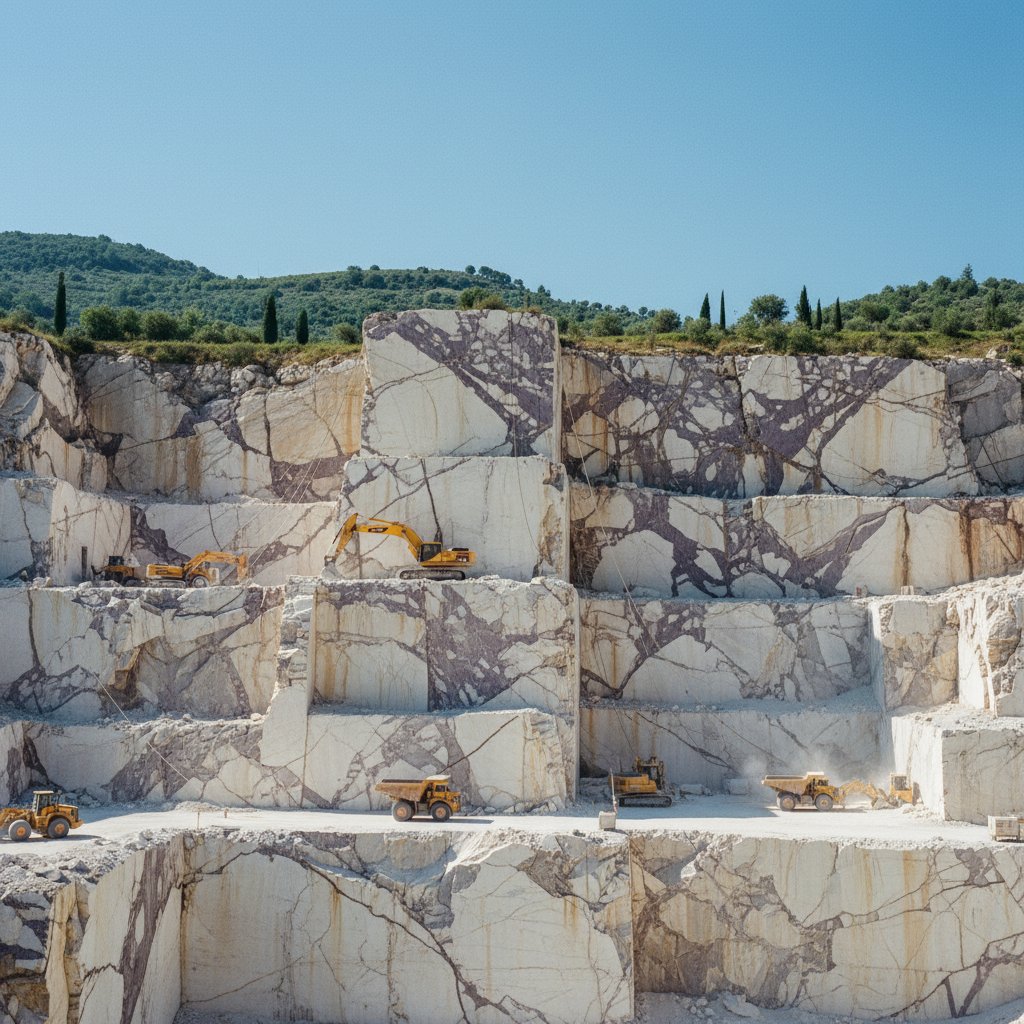
The pigmentation is mineral, not surface treatment, and does not fade with light exposure. Calacatta Viola installed in a sun-flooded room in 1990 (had any been installed; the stone was barely commercially classified at that point) would still show the same purple veining today. This is one of the stone's quiet strengths: unlike some pigmented finishes, the violet character is the rock itself.
From Quarry Anomaly to Designer Reference Stone
The honest history of Calacatta Viola as a named commercial grade is short. The Apuan quarries have produced violet-veined blocks for as long as they have produced any marble, but for most of their two-thousand-year history those blocks were treated as anomalies and either rejected as off-spec, used for utility work where the unusual colour didn't matter, or shipped to specific Italian regional markets where the violet was prized. The unified commercial classification of Calacatta Viola as a premium named stone is a development of the past fifteen years.
The trend arc begins around 2018 in the European luxury design press. Joseph Dirand, the French architect and interior designer, specifies Calacatta Viola in a Paris apartment that gets published in AD France in late 2018. The pieces show the stone in unexpected applications: a dining table base, a powder room vanity, a freestanding kitchen island. Within eighteen months, the stone is appearing across Italian, French, and Belgian shelter magazines, mostly through the work of designers in the same intellectual orbit as Dirand: Vincent Van Duysen, Studio KO, Pierre Yovanovitch.
The North American moment lags Europe by roughly two years. By 2021 Calacatta Viola is appearing in U.S. design press through projects by Kelly Wearstler, Tamara Magel, and several New York-based designers working in luxury residential. By 2022 Toronto designers have caught the wave; Studio Paolo Ferrari and several local interior designers begin specifying it in residential commissions across Forest Hill, Rosedale, and Yorkville. Pietra began stocking the stone in 2024 in response to repeated client requests.
Whether Calacatta Viola becomes a long-term design reference or a stone primarily identified with the late 2010s and early 2020s is an open question. The trend stones of the previous decade (Pietra Cardosa, certain Italian onyxes, the brief moment for Patagonia Quartzite) had similar arcs of intense five-to-eight-year favour followed by retreat into specific niche use. Calacatta Viola has more raw visual character than most of those predecessors, which suggests it may settle into longer-term niche prominence rather than fading. The honest answer is we will know in five years.
The Designer-Identified Stone
Calacatta Viola does not have the multi-century institutional history of Carrara White or Calacatta Gold. Its canonical references are recent residential commissions and a small number of hospitality projects from the past seven years. A short list of work that helped establish the stone:
- Joseph Dirand Paris apartment (2018). The originating reference for the contemporary trend. Published in AD France late 2018; the pieces showed Calacatta Viola in a dining table base and powder room.
- Kelly Wearstler residential commissions, Los Angeles (2020-present). The American designer began specifying Calacatta Viola in California residential projects from 2020 onward, often paired with brushed brass and natural plasters.
- Vincent Van Duysen residential, Antwerp (2020). A near-monochrome interior with Calacatta Viola as the single chromatic element, balanced against pale plaster walls and white-oak joinery.
- Studio Paolo Ferrari residential, Toronto (2022-present). Several recent commissions in Forest Hill and Rosedale specify Calacatta Viola in primary baths and powder rooms.
- Aman New York spa (2022). Jean-Michel Gathy specifies Calacatta Viola in select treatment-room surfaces.
Among living designers, the contemporary figures most consistently identified with the stone are Joseph Dirand (the originator of the contemporary moment), Kelly Wearstler (the most prominent American specifier), Vincent Van Duysen (the Belgian counterpoint), Pierre Yovanovitch, and in Toronto Studio Paolo Ferrari.
The Painterly Italian
Calacatta Viola's defining visual signature is painterly drama. The white field is warmer than Carrara, with slight cream undertones. The veining flows in dramatic gestural patterns that range across grey, violet, charcoal, and sometimes amber. The character is closer to abstract painting than to the linear veining of Calacatta Gold or the soft cloudwork of Carrara. Two slabs of Calacatta Viola from the same quarry can read as completely different stones; the variation within the named category is the widest in the Italian marble market.
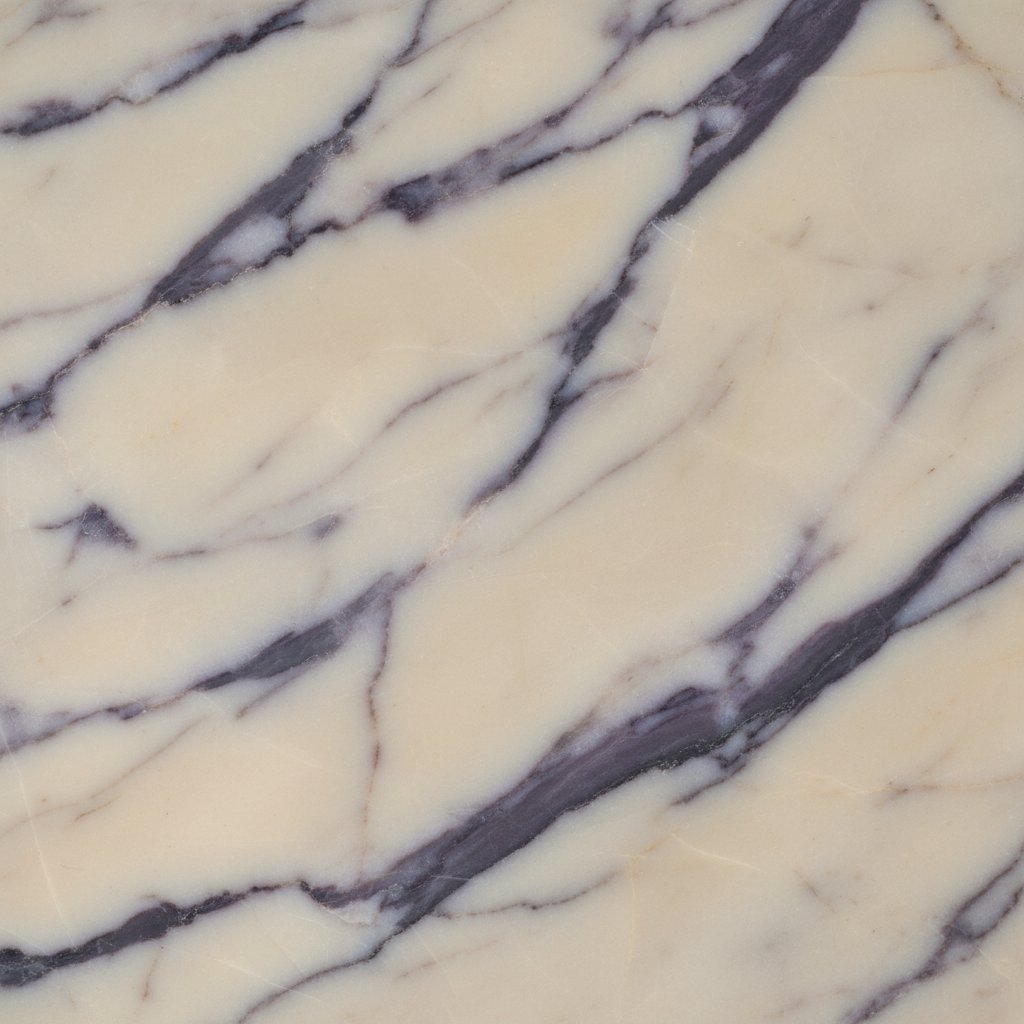
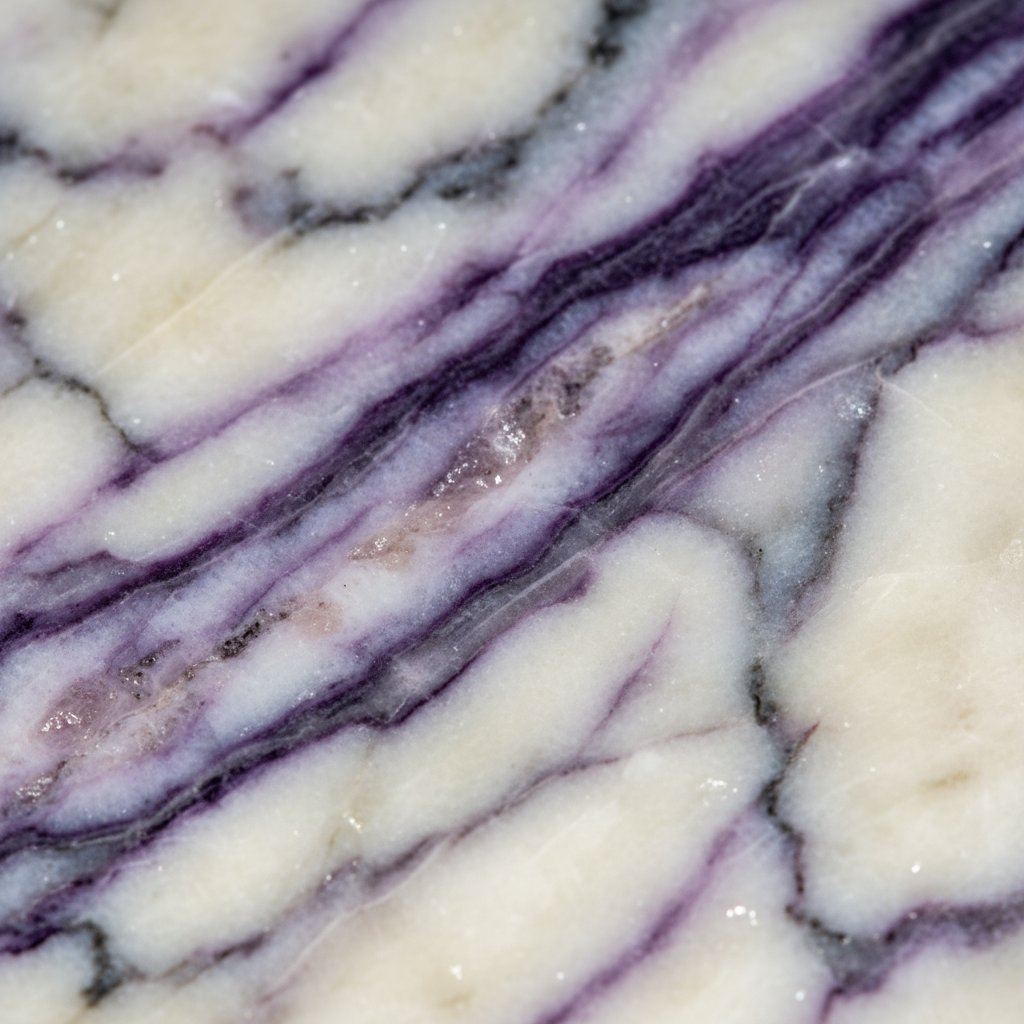
This variation is both the stone's strength and its specification challenge. For projects where the violet character is the design intent, slab selection matters more than for any other marble. Pietra works from photographs of actual reserved slabs at our quarry partners before cutting; for high-stakes Calacatta Viola commissions we strongly recommend that clients review slab photos personally or, ideally, fly to Carrara to select in person. A stone this dramatic does not survive a casual specification.
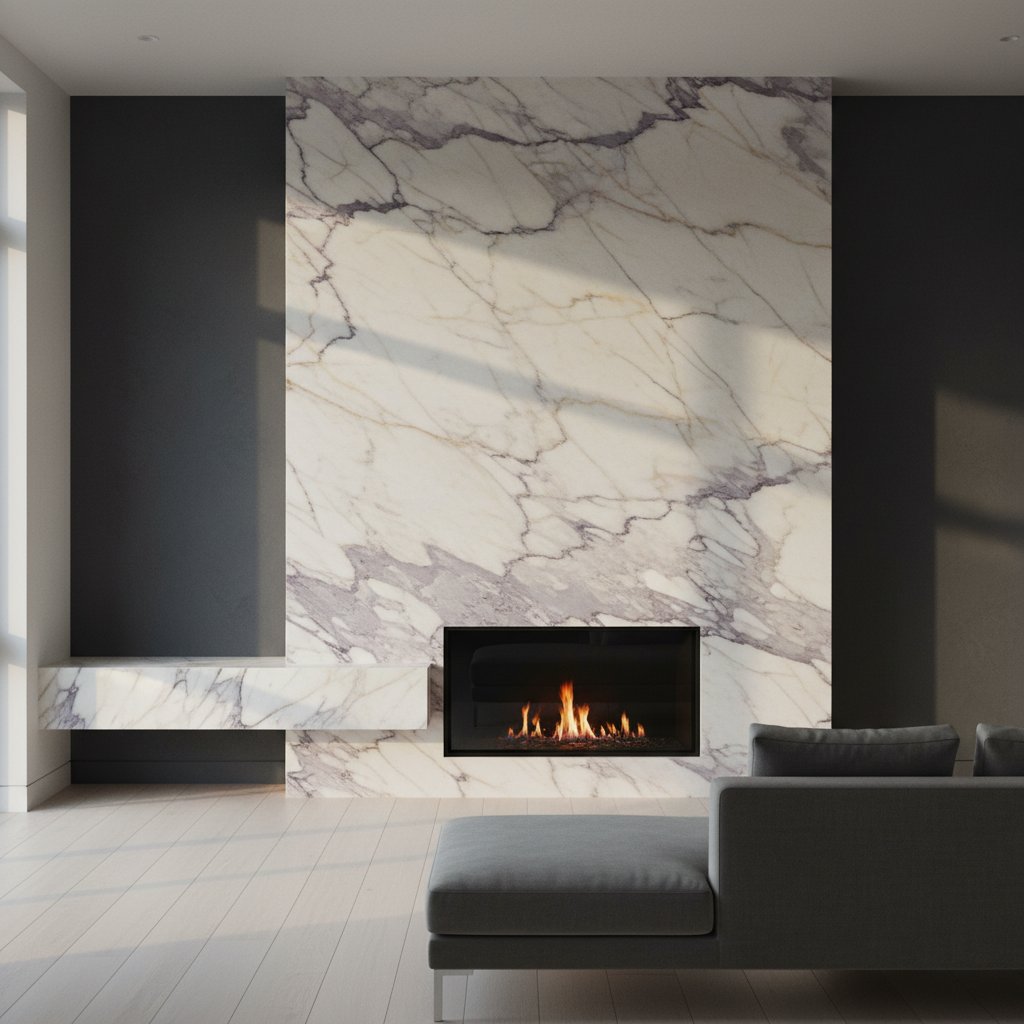
For larger installations that require multiple slabs (a full-wall fireplace surround, a long counter, bookmatched cladding), the variation between slabs becomes particularly important. Bookmatched Calacatta Viola compositions are extraordinary when the slabs are well-matched; chaotic when they aren't. Shop drawings should specify exact slab pairing intent before cutting.
The Violet at Different Light Registers
Calacatta Viola accepts the same four finishes as the rest of the Italian marbles. Finish choice changes how the violet veining reads more dramatically than for almost any other marble.
Polished brings the violet character to maximum intensity. The reflective surface deepens the purple tones and sharpens the contrast between vein and field. Polished Calacatta Viola in good light is one of the most visually arresting stones in the entire luxury marble market; in a dim space it can read as oppressive. The trade is real: this finish wants light to live in.
Honed takes the surface to a soft matte. The violet recedes from saturated to ghostly; the warm grey becomes the dominant veining tone. Honed Calacatta Viola is the safer specification for projects where the violet is meant to be a quiet feature rather than the room's organising statement. It also pairs more naturally with matte plasters and warm woods.
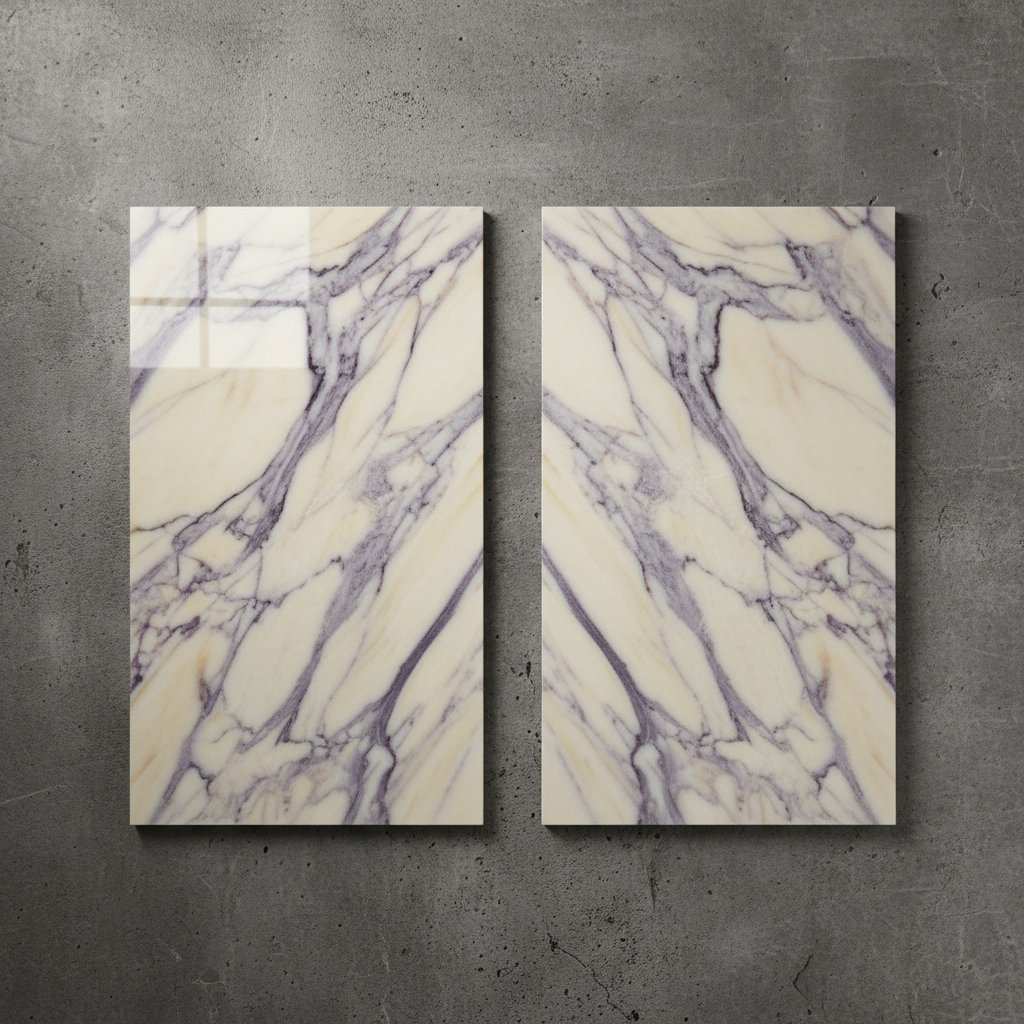
Leathered introduces tactile texture and reads as moodier still. The violet veining catches and releases light differently across the brushed grain, creating subtle shifts in apparent colour as the viewing angle changes. Leathered Calacatta Viola is rare but striking on horizontal surfaces (kitchen islands, bath counters) where the touch quality is part of the experience.
Brushed creates more pronounced texture and is mostly used for industrial-luxury applications. Pietra rarely specifies brushed Calacatta Viola; the stone's value is so tied to its colour drama that texture-heavy finishes can read as wasted.
The Premium Trend Stone
Calacatta Viola is calcium carbonate. The same etching-from-acid concerns that affect Calacatta Gold and the rest of the Apuan family apply here. Lemon, vinegar, wine, tomato, and acidic cleaners all create permanent matte spots on the polished or honed surface. The dramatic veining can hide minor etching better than a uniform field would, but significant etching reads against the polish regardless.
What separates Calacatta Viola practically is supply uncertainty and price volatility. The stone is in active commercial demand, supply is limited, and lead times can stretch significantly during peak periods. Pietra typically holds working inventory of standard-grade Calacatta Viola but special-grade slabs (the most dramatic violet-veined blocks) are usually special-order with quarry-confirmed reservation. Plan eight to twelve weeks of additional lead time for premium-grade Calacatta Viola specifications during periods of high market demand.
Calacatta Viola works in:
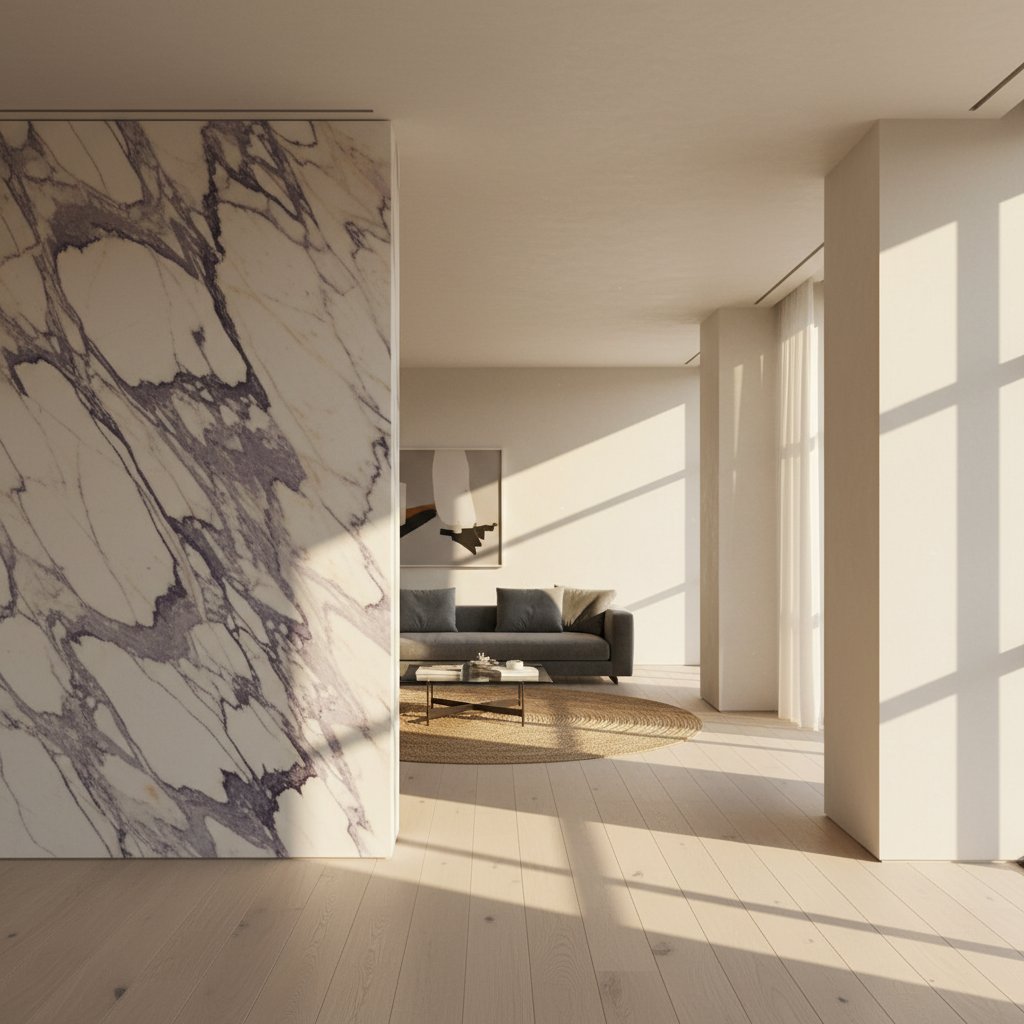
- Hero pieces. A single dramatic vanity, a fireplace surround, a bookmatched feature wall, a freestanding bath. Applications where the stone is the focal element.
- Powder rooms. The intimate scale and short visit duration are ideal for the stone's dramatic character. A powder room is a small space where a single dramatic gesture can hold for the whole experience.
- Primary baths in luxury residential. Where the stone reads as a daily luxury rather than a passing visitor.
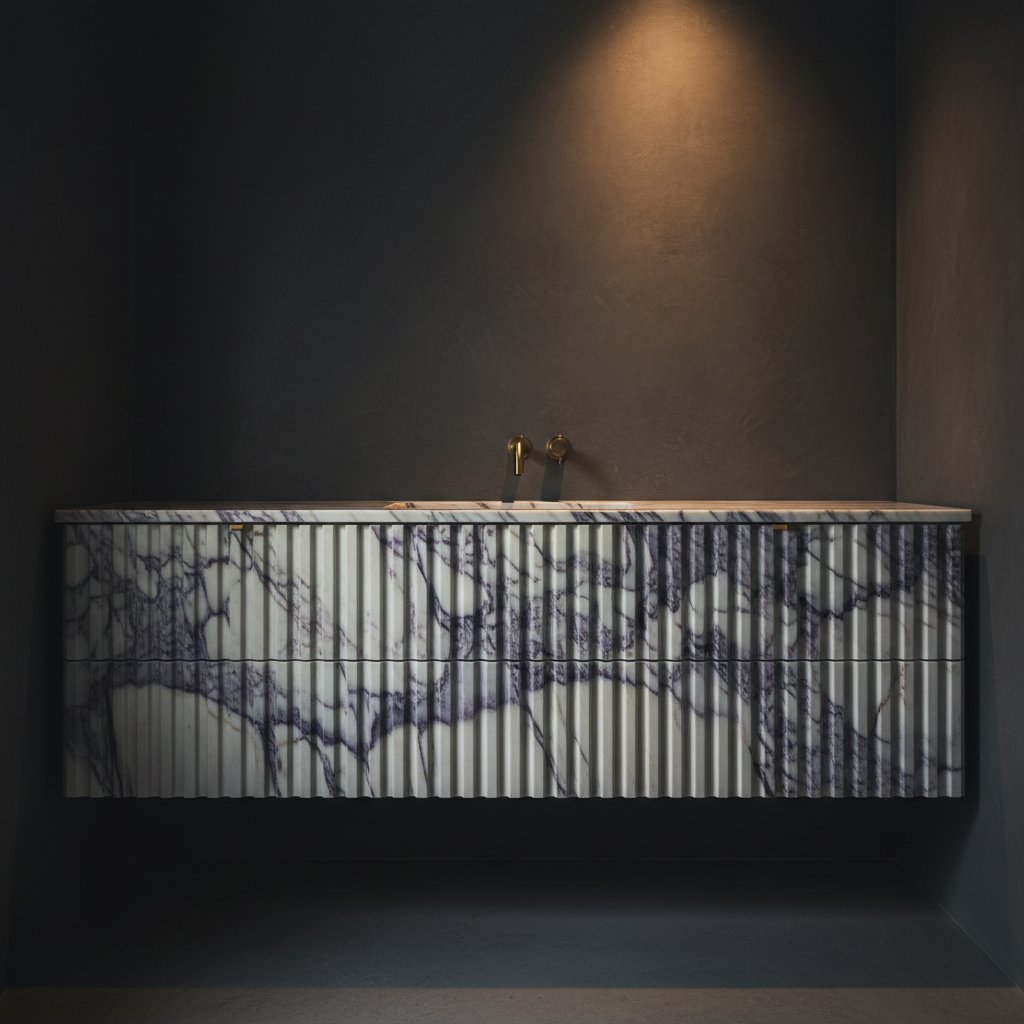
- Carved profiles. Fluted vanities, ogee edges, and reeded panels in Calacatta Viola produce some of the most distinctive contemporary fabrication work we do.
It is risky in:
- Large-volume installations across multiple slabs. Slab variation can produce visual chaos if not carefully managed at the spec stage.
- Spaces with poor light. The polished finish needs light to perform; the honed finish loses much of the violet character.
- Conservative interiors. The stone is too distinctive for projects where a calmer marble is the design intent. Calacatta Viola in a traditional interior is usually a misspecification.
- Outdoor applications in Toronto. Same freeze-thaw concerns as all calcium carbonate stones.
Sealing. Same protocol as the other Apuan marbles: penetrating sealer at fabrication, re-sealing every twelve to eighteen months. The deeper veining can occasionally show subtle dampness if water is allowed to pool on an unsealed surface; sealing prevents this.
Pricing. Pietra pricing varies by stone grade, profile complexity, and project scope. Send your project for a firm quote within one business day.
What Calacatta Viola Wants Around It
Calacatta Viola is itself the design statement. What it wants around it is restraint that frames the stone without competing with it. The successful pairings are the ones that use Calacatta Viola as the singular focal element and let everything else recede.
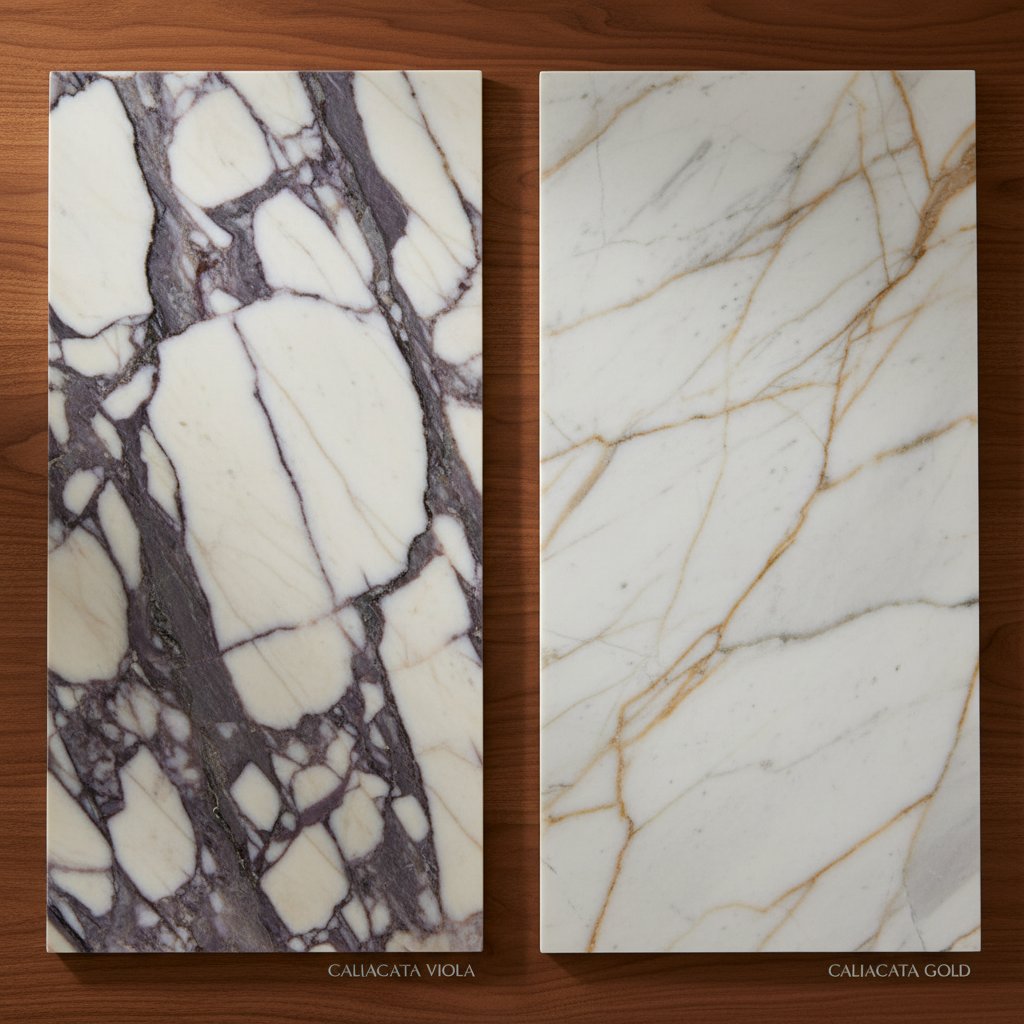
Calacatta Gold. The two Calacatta siblings can pair beautifully when used in different rooms of the same project (a Calacatta Gold kitchen, a Calacatta Viola powder room) or in deliberately separated applications within a single room. The shared white field connects them; the contrast in veining colour does the rest. Use carefully; pairing them on adjacent surfaces tends to produce competition rather than dialogue.
Carrara White. The most reliable pairing partner. Carrara as the calm field, Calacatta Viola as the punctuation. Common in master bath designs where a Carrara floor and shower enclosure provide the architectural envelope and a Calacatta Viola vanity provides the dramatic focal element.
Pale plaster walls in cream or putty. The warmest possible architectural envelope for the violet stone. The plaster picks up where the marble leaves off; the matte surface contrasts the polished stone without competing for the eye.
Materials Calacatta Viola always works with
- Brushed brass and aged bronze. The warm metal tones complement the violet veining in a way that cooler metals (chrome, polished nickel, stainless) cannot. Brushed brass is the canonical Calacatta Viola partner.
- White-oak millwork. The warm wood tone provides tonal continuity with the warm white field of the marble; the wood grain provides textural contrast to the polish.
- Smoked-oak and walnut for darker contrast. When the design intent is moodier, deeper wood tones work beautifully against the marble's violet drama.
- Limewash and lime plaster walls. Particularly in cream, putty, and mushroom tones. The matte mineral surface picks up the same geological language as the marble.
What to avoid
Calacatta Viola does not pair well with other dramatic veined stones. The combination of Calacatta Viola and Calacatta Borghini, or Calacatta Viola and Sahara Noir, or Calacatta Viola and busy patterned marbles tends to produce visual chaos because each material is competing for the role of focal stone. The same restraint principle as Calacatta Gold applies: one bold gesture, well framed.
For the bath
For a Calacatta Viola vanity (the most common application we fabricate), the surrounding palette wants to be intentionally quiet. Pale plaster walls, brushed brass faucets and hardware, white-oak shelving or millwork, soft warm lighting. Chrome fixtures fight the violet; matte black fixtures can work if the rest of the palette supports the moodier register.