A Jurassic Seabed in the Apuan Alps
Calacatta Gold begins as calcium carbonate sediment on the floor of the Tethys Sea about 190 million years ago, in the early Jurassic. Marine organisms accumulate over millions of years into thick limestone deposits. Plate tectonics buries the limestone, then heat and pressure metamorphose it into marble. The Apennine orogeny lifts the metamorphosed rock to the surface, where it forms the Apuan Alps in northwestern Tuscany. The same geological process produced Carrara White and Statuario nearby; the variations in iron oxide and other trace minerals during burial determine which name the stone eventually carries.
What distinguishes Calacatta Gold from its siblings is the iron oxide concentration in the secondary mineralisation. As fluids percolate through the bedded marble, iron is deposited along fault lines and bedding planes. When that iron oxidises during exhumation, it gives the stone its signature gold-to-warm-grey veining. The wider and more saturated the gold veining, the rarer and more valuable the slab.
- Original rock: Limestone (sedimentary) from the Jurassic period, ~190M years old
- Metamorphism: Pressure and heat from Apennine orogeny, ~30M years ago
- Veining mineral: Oxidised iron deposited along fault lines
- Sister stones from same range: Carrara White, Statuario, Calacatta Borghini
- Hardness: Mohs 3-4 (a relatively soft stone)
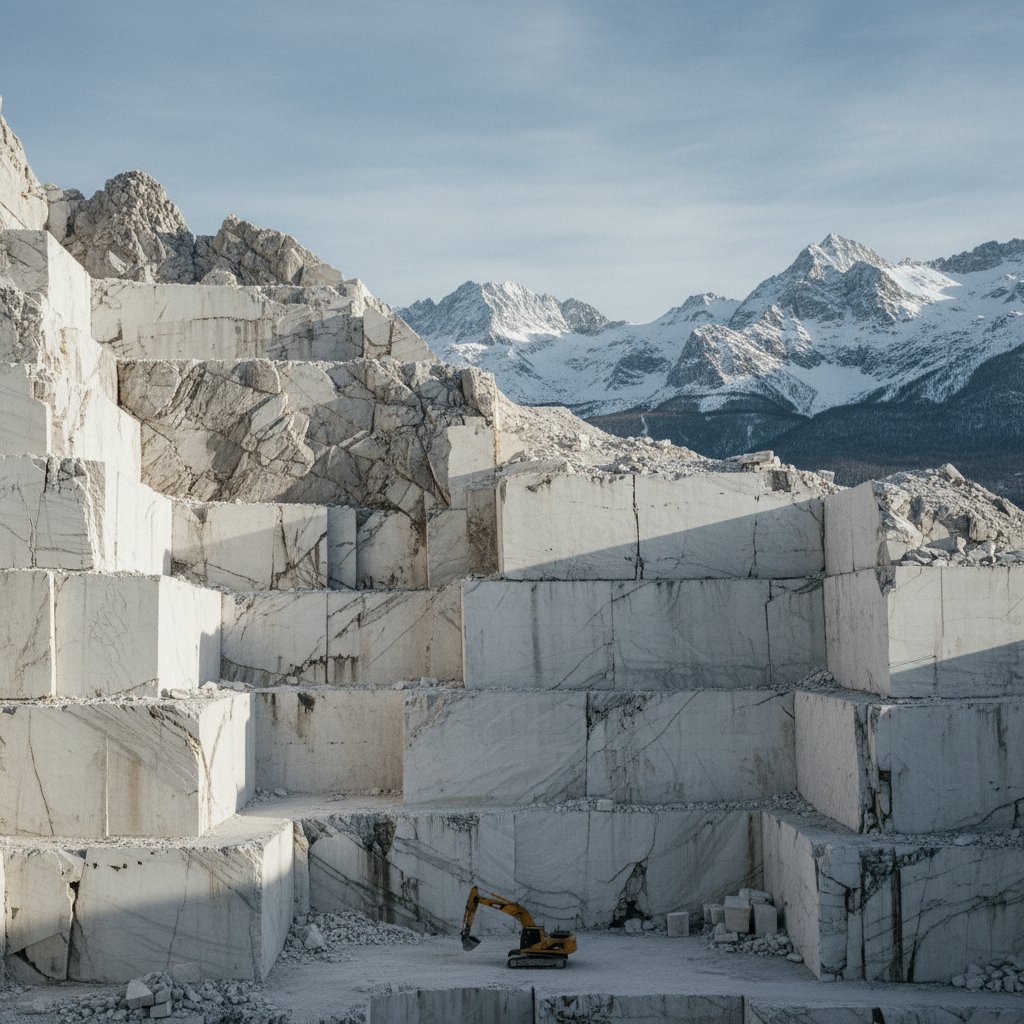
The Calacatta Gold name applies to several specific quarries in the upper Apuan Alps. The most coveted variant is Calacatta Borghini, named for the Borghini quarry, where the gold veining tends to be wider and more amber-toned. Calacatta Vagli, from the Vagli area further north, has a slightly cooler gold and a finer secondary vein structure. Calacatta Macchia Vecchia is rarer still, with dramatic painterly veining that can read almost like landscape painting on a polished slab. When Pietra specifies Calacatta Gold without a sub-name, we work with our quarry partners to source from whichever vein in the larger family best matches the project's aesthetic and budget.
Two Thousand Years of Continuous Extraction
The Romans began industrial quarrying in the Carrara hills around 155 BCE, under the consul Marcus Aemilius Lepidus. By the reign of Augustus, the quarries had become an imperial enterprise. The white marbles of Luna (the Roman name for the Carrara region) were shipped down the Frigidus river, loaded onto barges at the port of Luni, and distributed across the Mediterranean. The Pantheon, Trajan's Column, the Ara Pacis, and the Forum of Augustus all draw on stone from these quarries. The Calacatta varietals as a named category came later, but the same marble strata have been worked continuously since.
The Renaissance is when the Apuan stones acquire their reputation as the marble of the masters. Michelangelo travels personally to the quarries above Carrara to select blocks for the Pietà (1499), the David (1504), and the unfinished Slaves. The stone he sourced for those works was technically a fine-grained Statuario, the cousin of Calacatta Gold, prized for its uniformity. The painterly Calacatta variants, with their bold veining, came into favour later for architectural rather than sculptural use, where the veining could be read as a feature rather than a distraction from form.
Through the Baroque, Neoclassical, and Beaux-Arts periods, Calacatta marbles populate the floors and walls of palaces, opera houses, and grand civic buildings across Europe and, eventually, the United States. The 1893 Chicago World's Fair brings Carrara stone to American architectural fashion at scale; the resulting wave of marble specification through the early 20th century puts Calacatta Gold and its variants in the lobbies of buildings like the Woolworth (1913) and into the foyer of nearly every Beaux-Arts mansion built between 1890 and 1930.
Modernism complicates the story. Mid-century architects largely turn away from heavily veined marbles, preferring the cooler, more uniform Carrara White or the wholly synthetic terrazzos. Calacatta Gold spends much of the 1950s through the 1980s as a stone for traditional renovation work rather than new construction. The revival begins in the late 1990s with the rise of a particular flavour of luxury minimalism: architects like Peter Marino, John Pawson, and Vincent Van Duysen begin specifying Calacatta varieties in spaces that frame the stone as a single dramatic gesture rather than wallpapering an entire room with it. That framing logic is still how the best contemporary work uses the material.
From the Pantheon to One57
A short list of buildings and projects where Calacatta Gold or one of its close family members performs a major role:
- The Pantheon, Rome (113-125 CE). The original interior used a mix of stones from the Apuan range, including Carrara and what would later be classified as the Calacatta family.
- Michelangelo's Pietà and David (1499, 1504). Statuario, the close cousin to Calacatta Gold, sourced personally from the quarries above Carrara.
- The Woolworth Building lobby, New York (1913). Cass Gilbert specified Calacatta family marbles for the floors and wainscoting of what was then the tallest building in the world.
- One57, New York (2014). Christian de Portzamparc's residential tower uses Calacatta Borghini in the lobby and in select apartment kitchens. The pieces are bookmatched, dramatising the gold veining as continuous rivers across full walls.
- Bulgari Hotels, multiple locations. Antonio Citterio's interior architecture for the Bulgari brand specifies Calacatta varieties as a recurring material, often paired with dark woods and brushed bronze.
- Hermès flagship stores, Rena Dumas and successors. The Hermès interior architecture team has specified Calacatta Gold in flagship locations from Tokyo to São Paulo, typically as a single hero element (a counter, a stair, a screen) rather than as a finish surface.
Among living designers, the contemporary figures most identified with the stone are Peter Marino (Calacatta as a sculptural element in Chanel and Louis Vuitton retail interiors), Vincent Van Duysen (Calacatta in restrained near-monochrome interiors that let the stone do all the work), John Pawson (the same logic applied to monastic minimalism), and Studio Paolo Ferrari in Toronto, who has used Calacatta Gold to powerful effect in several recent residential commissions across the GTA.
Reading the Stone
Calacatta Gold's defining visual signature is the contrast between three elements: a bright white field, bold primary veining in gold-to-amber tones, and finer secondary veining in warm grey. The white is true white and reads cool, but the warm tones in the veining shift the overall temperature of the stone toward warm. It plays beautifully against warm woods (white oak, walnut), brushed brass and bronze, and warm-tone plasters. It can clash against cool greys and pure chrome unless the cool elements are used sparingly as accents.
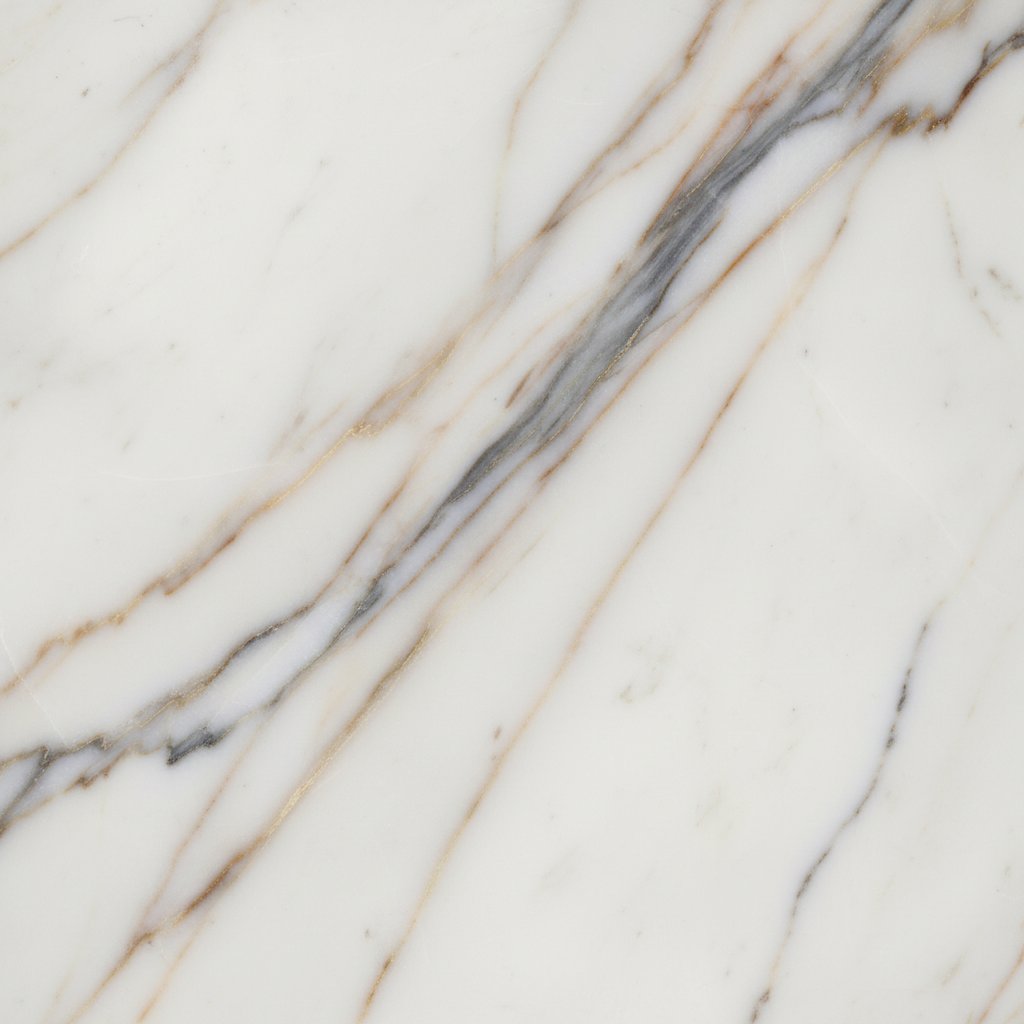
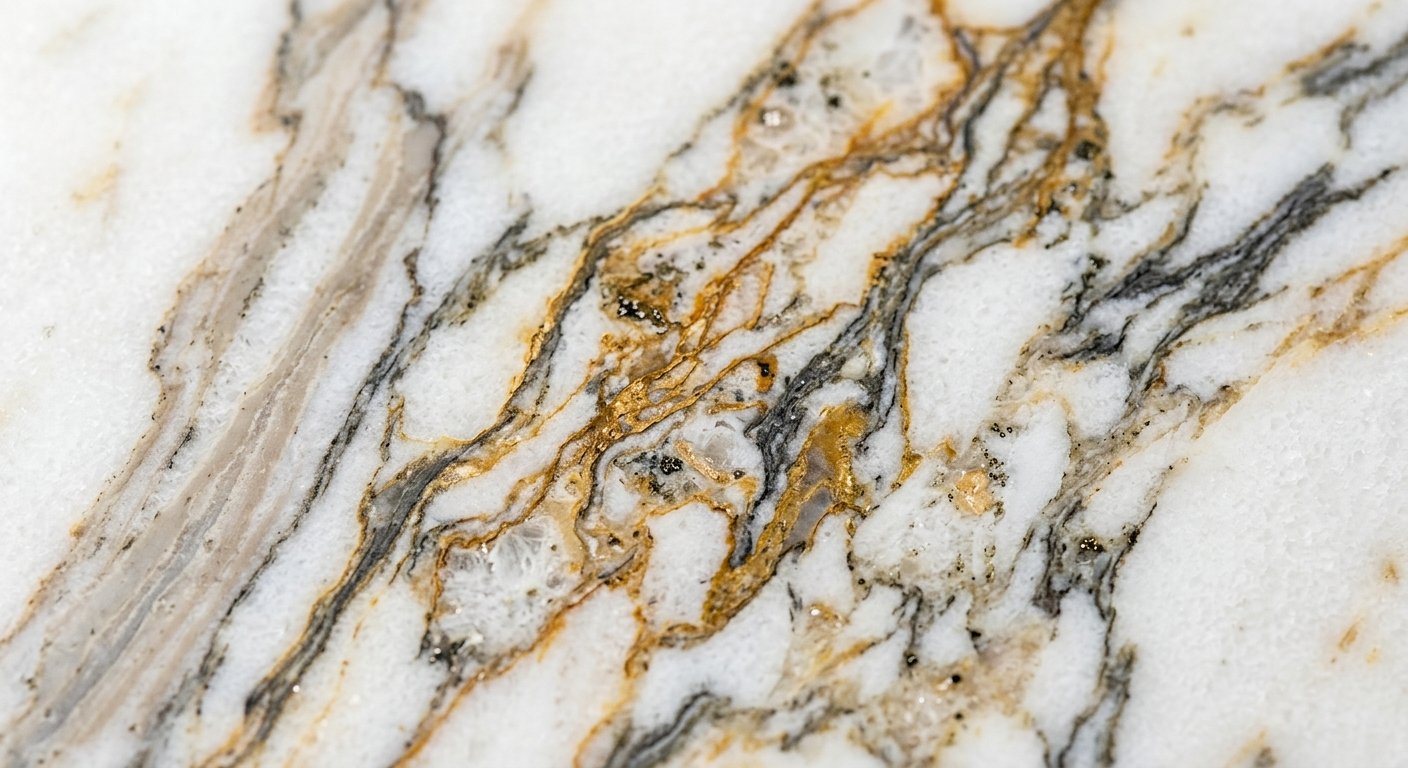
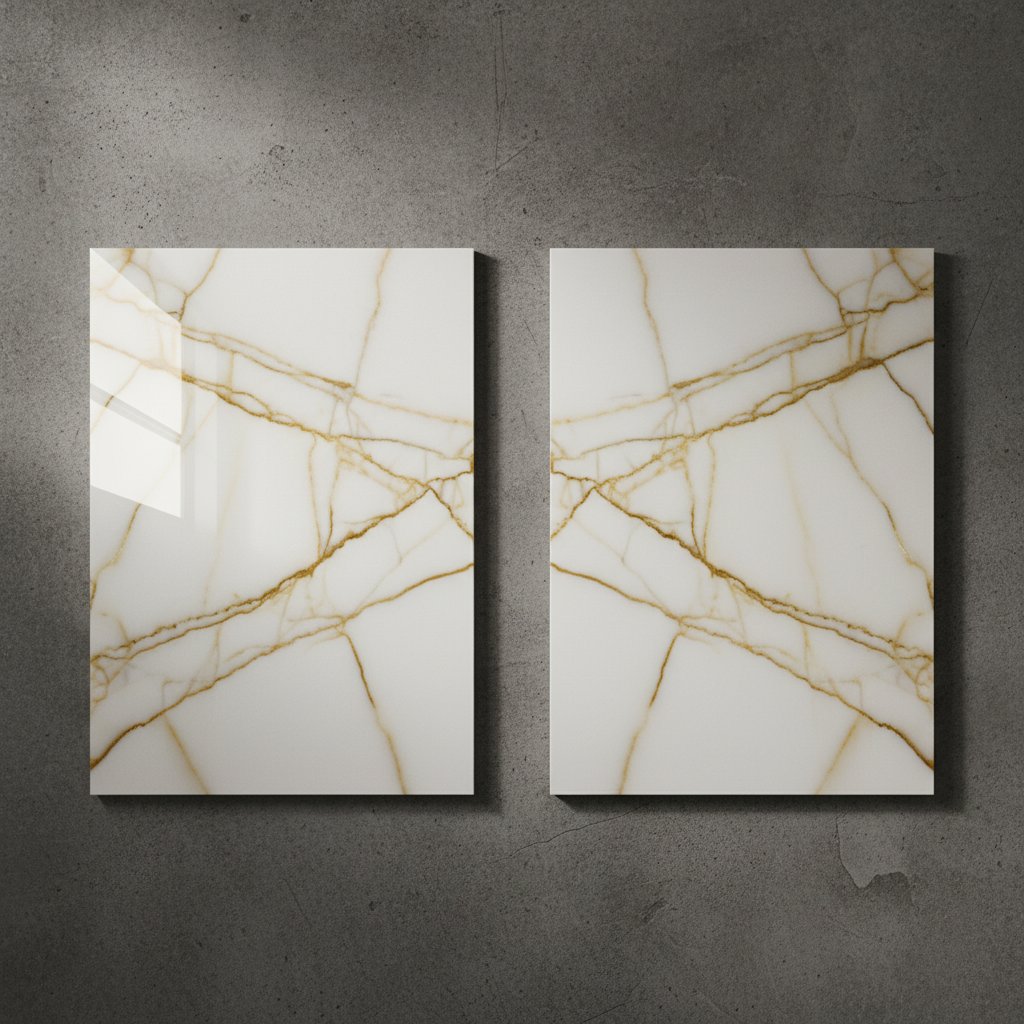
Vein direction matters. Calacatta Gold slabs are quarried in blocks that have a clear bedding plane, and the veining flows in a primary direction within that plane. Fabricators cut perpendicular or parallel to the bedding depending on the desired effect: parallel cuts emphasise the linear gesture, perpendicular cuts produce a more chaotic field of intersecting veins. For pieces like cased openings or vanities where two adjacent panels meet, the question of how the veining will continue across the joint is decided at the shop drawing stage. For wall installations of two or more slabs, bookmatching (mirroring adjacent slabs along their shared edge) creates the dramatic Rorschach compositions that define the stone's contemporary use.
No two slabs of Calacatta Gold are identical. The veining variation within the named category is wide, from pieces with a single bold vein bisecting a near-pure white field, to densely veined pieces where the gold runs across the entire surface in a network. When Pietra specifies the stone for a project, we work from photographs of the actual slabs at our quarry partners before cutting. For high-stakes projects, clients are welcome to fly to Carrara to select the slab in person; a number of our designer clients build it into the project schedule as a matter of course.
How Light Reads Off the Stone
Calacatta Gold accepts four common finishes: polished, honed, leathered, and brushed. Each one fundamentally changes how the stone reads in a space.
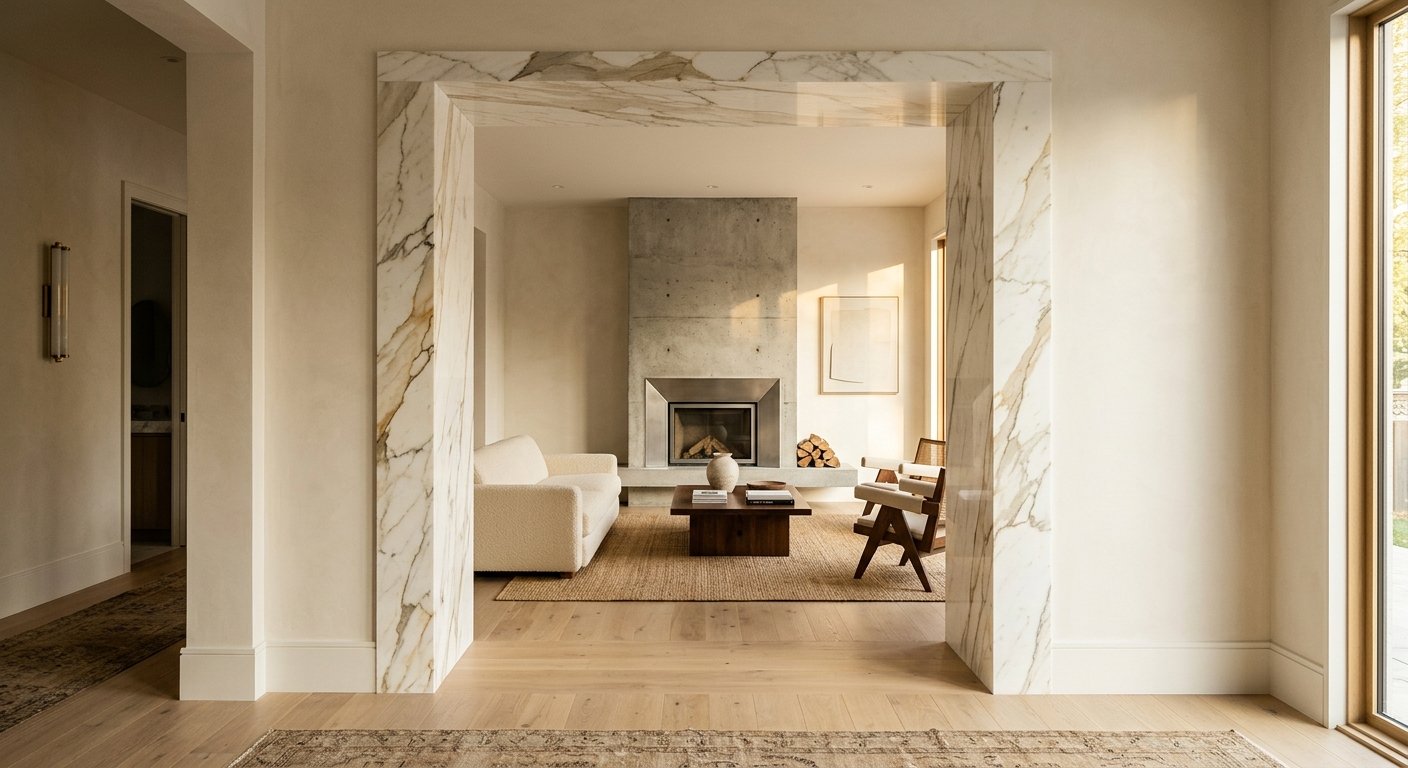
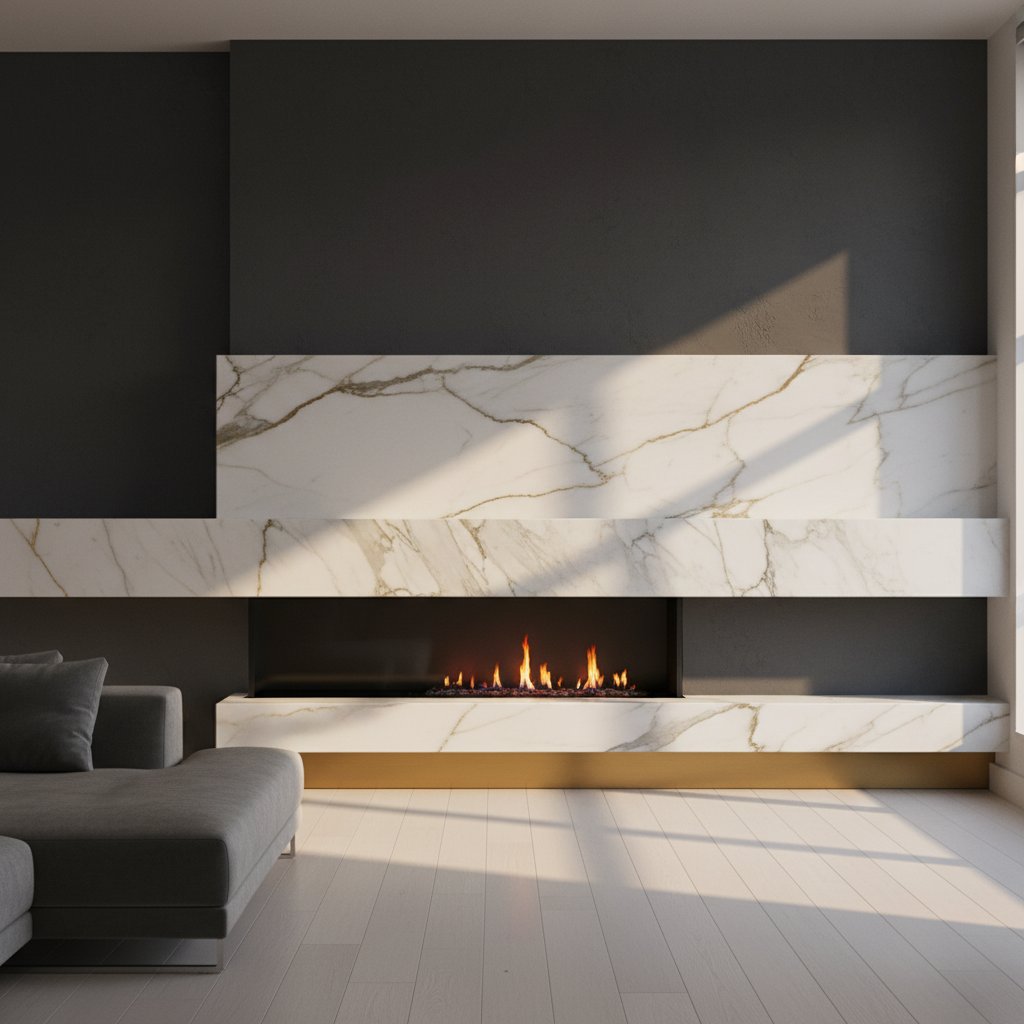
Polished is the traditional luxury finish. The surface is mechanically polished to a mirror-like reflectivity. The white field reads at maximum brightness; the gold veining pops with the most dramatic contrast. Polished surfaces show every fingerprint, water spot, and etch from acidic substances, but they also bring the most visual energy. For a hero piece (a fireplace surround, a statement vanity, a cased opening) where the stone is meant to dominate, polished is the standard choice.
Honed takes the polishing process to a soft matte finish rather than full gloss. The white field reads slightly cooler and more uniform; the gold veining recedes into the surface rather than projecting from it. Honed Calacatta Gold is the choice for spaces where the marble is part of a quieter composition, or where a polished surface would be too reflective for the room's lighting. It also masks etching better than polished, which makes it more forgiving in higher-traffic applications.
Leathered introduces a tactile texture: the surface is treated with diamond brushes that follow the natural grain of the stone, creating a soft, subtly undulating finish that registers under light as a faint texture. Leathered Calacatta Gold is rare in luxury residential work; it tends to read as more rustic, and the gold veining can lose some of its visual punch. Where it works is on horizontal surfaces (table tops, bench tops) where the touch quality matters as much as the look.
Brushed is similar to leathered but with a more pronounced texture. It's mostly used for exterior applications or for industrial-luxury spaces (lofts, certain hospitality projects) where the stone is meant to feel less precious. Pietra rarely specifies brushed Calacatta Gold for residential work; the stone is precious enough that hiding the polish reads as a missed opportunity.
Living With a Calcium Carbonate Stone
The single most important fact about Calacatta Gold is its chemistry. The stone is calcium carbonate. Acidic substances react with calcium carbonate, etching the surface where they make contact. Lemon juice, vinegar, wine, tomato sauce, fruit juice, even hard water with a low pH will etch a polished Calacatta Gold surface over time. The etching is permanent in the sense that it can only be removed by re-polishing, which is a job for a stone fabricator rather than a maintenance step the homeowner performs.
This single fact determines where Calacatta Gold belongs and where it doesn't. It belongs on:
- Vanities, sinks, and bathtubs where exposure to acid is rare and water is typically near-neutral pH.
- Fireplace surrounds, archways, and door surrounds where contact is minimal and the stone is essentially a sculptural element.
- Wall panels and cladding where there's no horizontal exposure at all.
- Powder rooms and guest baths where use is light and the visual impact is the point.
It does not belong on:
- Kitchen countertops in active families. If you cook with citrus, vinegar, or tomatoes, the etching will accumulate. Kitchens are possible with Calacatta Gold, but with a deliberate willingness to accept patina as part of the material's character. Many of our most design-literate clients accept this trade. Most homeowners do not.
- Bar tops where wine and citrus mixers are common. Same reasoning.
- Outdoor applications in freeze-thaw climates. The stone is porous enough that water absorption followed by freezing will fracture it. Toronto winters are not its friend.
Sealing. Calacatta Gold should be sealed at fabrication and re-sealed every twelve to eighteen months thereafter, depending on use. Pietra fabricates with a penetrating sealer applied at the shop; we provide a re-sealing kit and instructions on delivery, and our installers can re-seal in place during a routine maintenance visit if you're a GTA full-service client.
Pricing. Pietra pricing varies by stone grade, profile complexity, and project scope. Send your project for a firm quote within one business day.
What Calacatta Gold Wants Next To It
Calacatta Gold pairs best with materials that either complement its warm tones or provide enough contrast to make the gold veining read as a feature. Three combinations work consistently well:
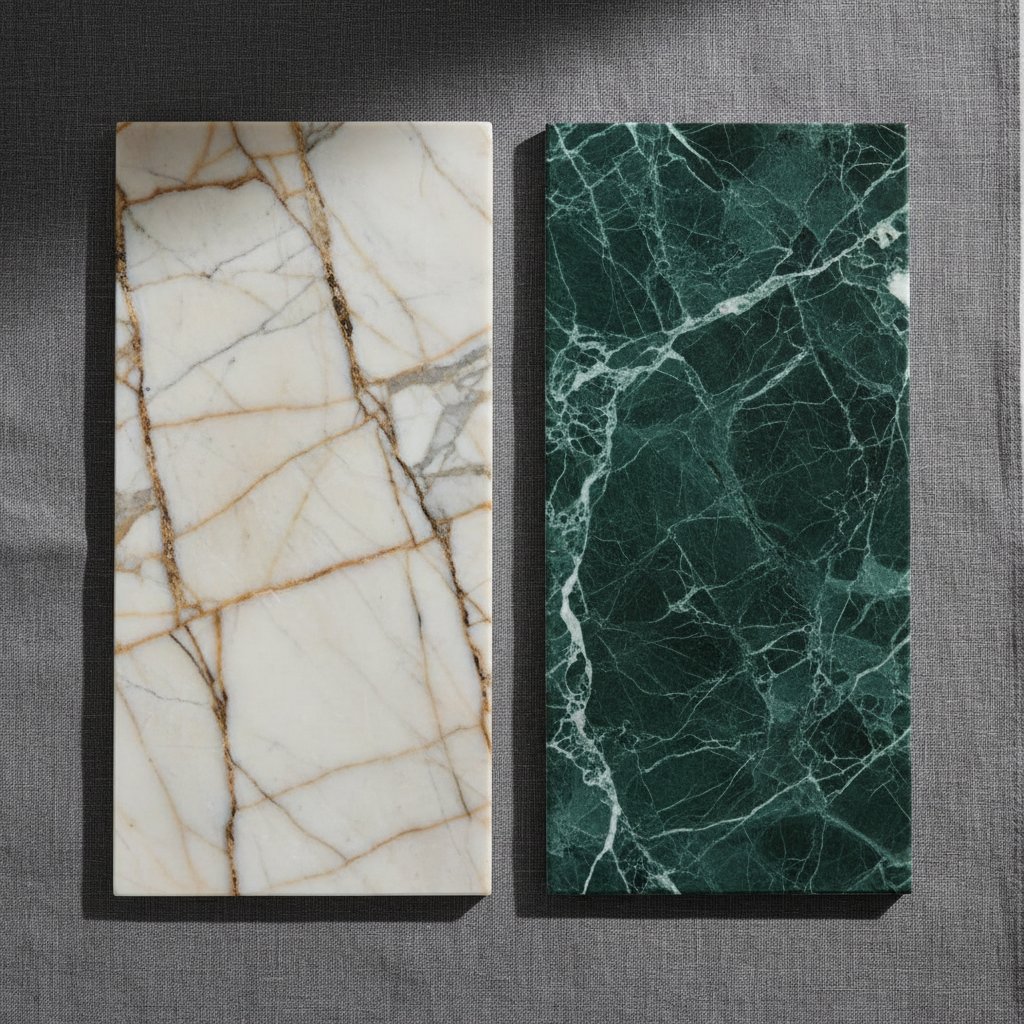
Verde Guatemala marble. The deep green of Verde Guatemala is the most exciting current pairing for Calacatta Gold. The two share a white field as a base note, but the dark serpentine green and the warm gold create a contrast that reads dramatic without being garish. We're seeing this combination in master bath designs (a Verde Guatemala vanity opposite a Calacatta Gold tub surround) and in archway-and-fireplace pairings within open-plan living rooms.
Sahara Noir marble. The dark brown-and-gold field of Sahara Noir is a near-perfect inversion of Calacatta Gold's white-and-gold field. Pairing the two within a single room, or even on adjacent surfaces, creates a deliberate dialogue between light and dark variants of the same gold-veined idea. The pairing requires a careful hand to avoid reading as too matched-set, but when it works it's striking.
Travertino Romano. The Roman travertine is the warm-tone complement to Calacatta Gold's cooler white field. Both stones come from the Italian peninsula, both have been used in monumental architecture for two thousand years. A travertine-clad room with a Calacatta Gold fireplace surround is a near-classical combination that still reads contemporary when the rest of the space is detailed in modern proportions.
What to avoid
Calacatta Gold should not be paired with other heavily veined dramatic stones unless the pairing is deliberately maximalist. Pairing Calacatta Gold with Calacatta Viola, Nero Marquina, or another aggressive marble in adjacent surfaces tends to produce visual chaos. The stone is itself the statement; what it needs around it is restraint.
For the bath
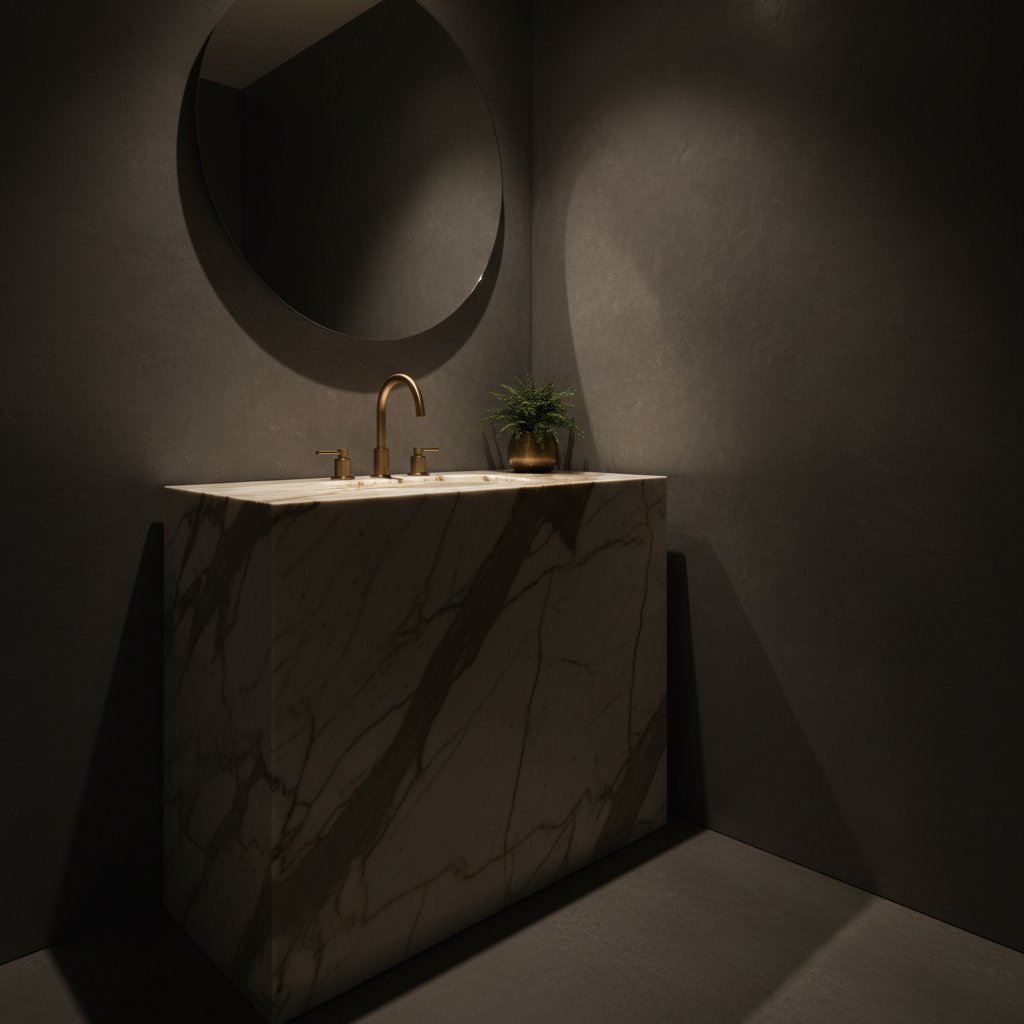
For a Calacatta Gold vanity (one of the most common applications we fabricate), the surround should typically stay quiet: dark plastered walls or warm wood panelling, brushed brass fixtures, polished concrete or wide-plank wood floors. The vanity is the hero; the room frames it.