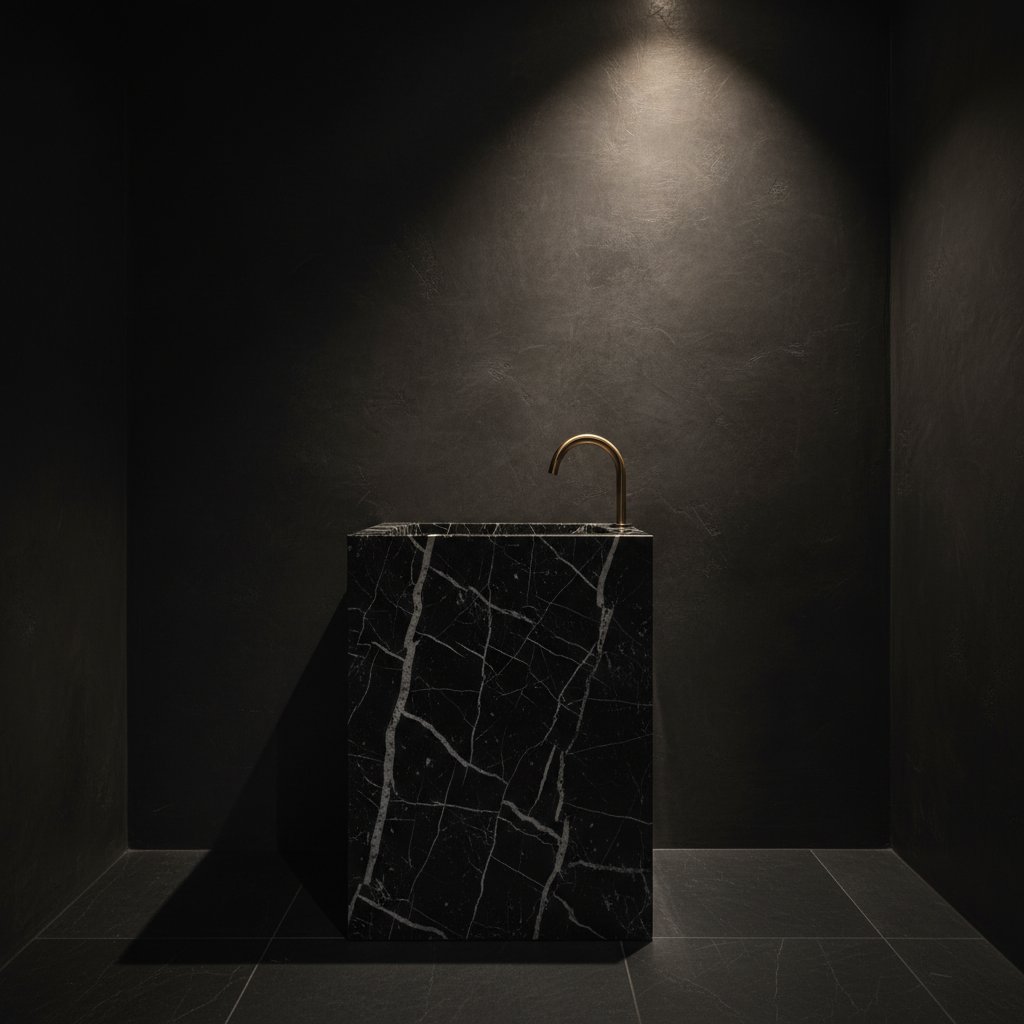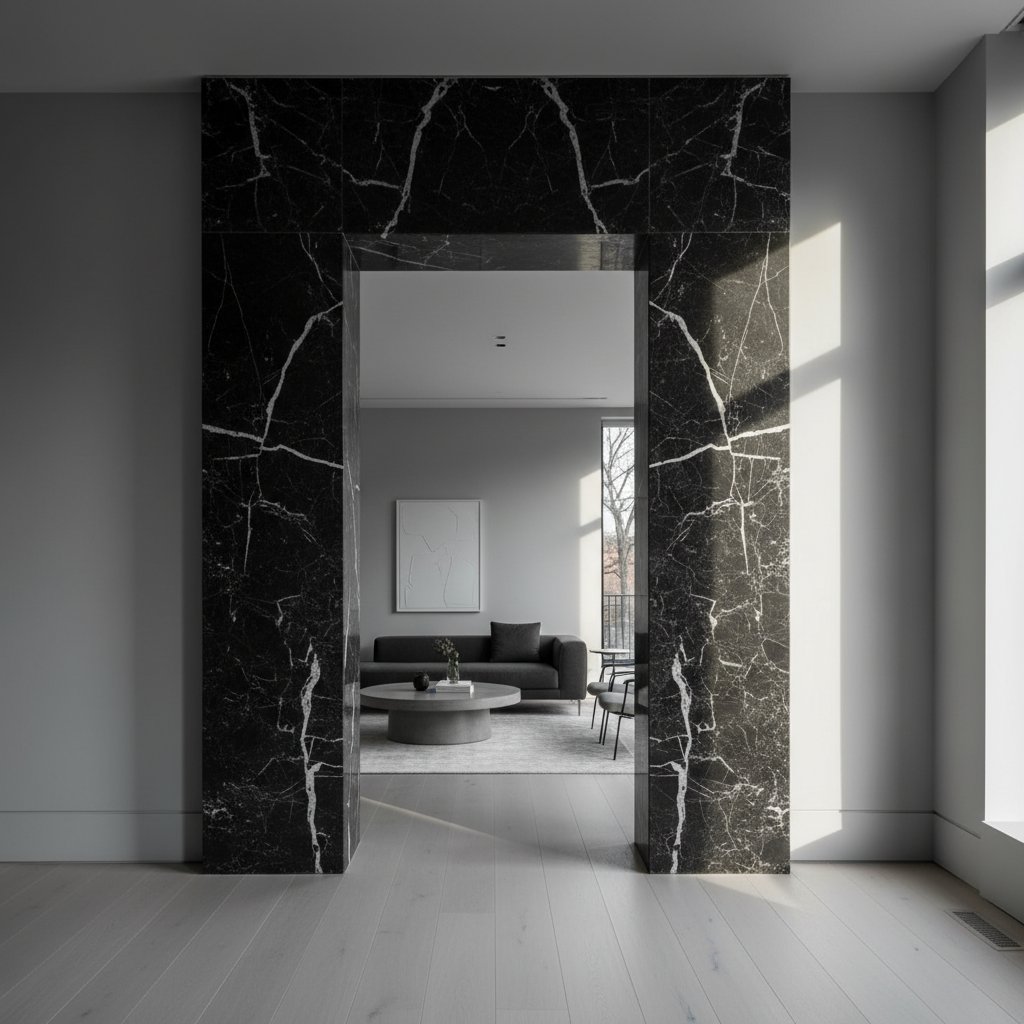
Carboniferous Black From the Basque Hills
Nero Marquina is older than the Italian marbles by a hundred and fifty million years. The stone formed from limestone deposits in the Carboniferous period, roughly 340 million years ago. The deposits accumulated on the floor of an ancient shallow sea where high concentrations of organic carbon, the remains of marine life, mixed with the calcium carbonate sediment. As the limestone metamorphosed under pressure, the carbon stayed in the stone, giving it the deep, near-black field that distinguishes it from any of the lighter marbles.
The active quarries sit in the green Cantabrian hills around the town of Markina-Xemein in the Spanish Basque Country, about forty kilometres east of Bilbao. The Spanish name for the stone, Nero Marquina, comes directly from the town. The most established commercial quarries belong to the Marbles La Sirena group; the regional industry has been continuous since at least the sixteenth century.
- Original rock: Limestone from the Carboniferous period, ~340M years old
- Veining mineral: Calcite intrusion along fault lines through the dark calcium carbonate base
- Field colour: Deep black to charcoal, depending on carbon content of the specific block
- Hardness: Mohs 3-4 (calcium carbonate, etches with acid)
- Sister dark stones: Sahara Noir (Tunisia), Saint Laurent (France), Nero Portoro (Italy)
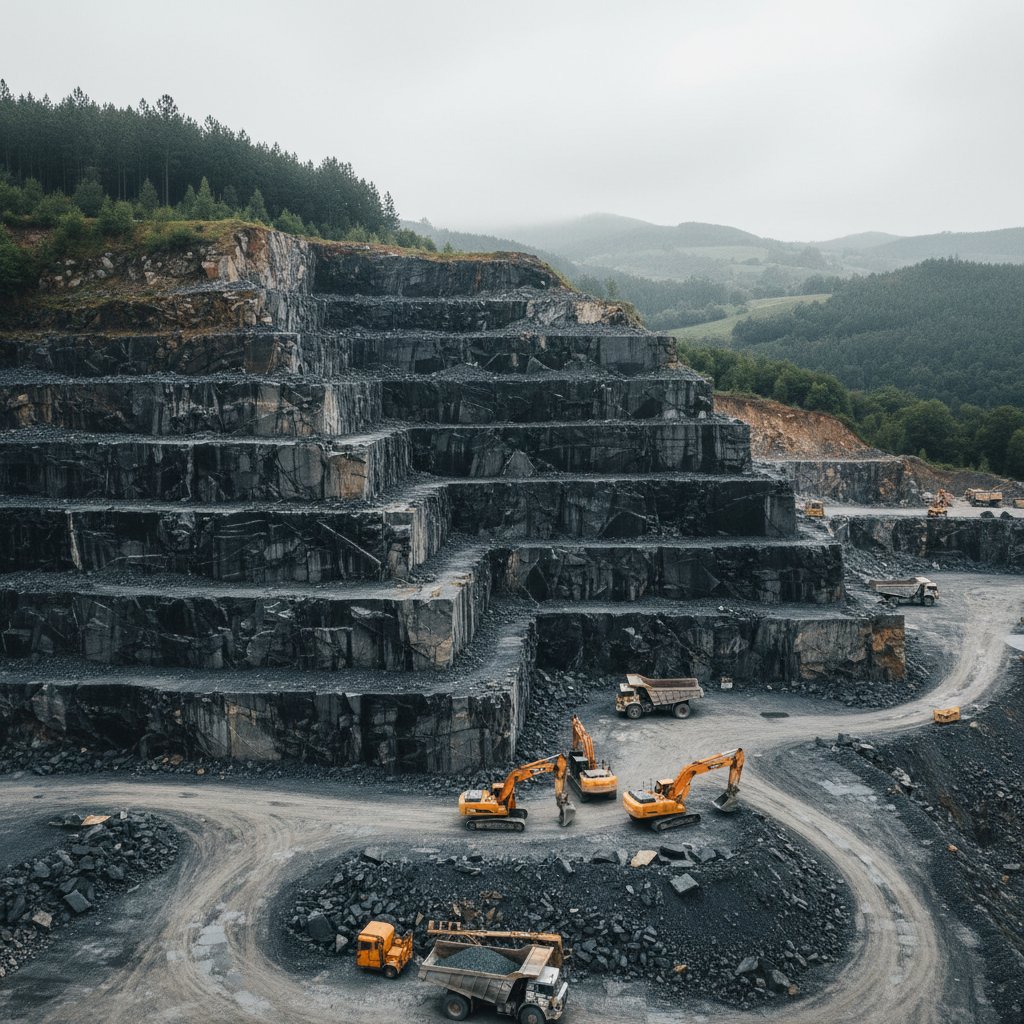
The white veining in Nero Marquina is calcite, deposited by mineralised water flowing through fault lines in the dark limestone over geological time. The veining tends to flow in sharp, narrow patterns rather than the broader cloud-like gestures of the Italian marbles. Within the named category there are sub-grades: Marquina Negro Standard (the most common, with moderate veining), Marquina Negro Extra (less veining, closer to a uniform black), and Marquina Negro Veta (more dramatic veining, prized for hero pieces).
Spanish Royalty, Then Global Minimalism
Nero Marquina has been quarried in the Basque Country since at least the sixteenth century, primarily for use in Spanish royal and ecclesiastical architecture. The Escorial monastery near Madrid (1563-1584) uses Spanish black marbles in several altars and royal chapels. The Royal Palace of Madrid (begun 1738, completed 1764) specifies Nero Marquina in formal floor inlays and key architectural elements. Much of the dark marble in Spanish baroque and neoclassical interiors of the seventeenth and eighteenth centuries draws on Nero Marquina or its closely-related Spanish siblings.
For most of the twentieth century, Nero Marquina sat as a regional Spanish stone with limited international circulation. That changed in the late 1990s and early 2000s with the rise of contemporary minimalism. Designers looking for a black material that read as architectural rather than decorative discovered the stone, and Nero Marquina became one of the defining materials of a particular flavour of luxury minimalism. Joseph Dirand's residential and commercial work in Paris uses Nero Marquina consistently. Vincent Van Duysen specifies it in Belgian and international residential commissions. Studio KO uses it across the boutique hotels they design.
The contemporary moment for the stone is now. The current preference for darker, moodier interiors (a reaction against the all-white interiors that dominated the 2000s and early 2010s) has put Nero Marquina at the centre of high-end residential and hospitality specification. Aman Hotels, Bulgari Hotels, several recent Aman and Six Senses properties: all draw on the stone. In Toronto specifically, Studio Paolo Ferrari has used Nero Marquina in several recent residential commissions across the city's higher-end markets.
From the Escorial to Joseph Dirand
A short list of buildings and projects where Nero Marquina performs a major role:
- The Escorial monastery, near Madrid (1563-1584). Spanish royal commission with black marble in several altar and royal chapel surfaces.
- The Royal Palace of Madrid (1738-1764). Formal floor inlays and architectural details specifying Nero Marquina alongside other Spanish marbles.
- Joseph Dirand residential commissions, Paris (2010-present). The French architect and interior designer uses Nero Marquina as a recurring material across multiple Paris apartments and commercial spaces. His own apartment, widely published, features the stone in the kitchen and primary bath.
- Vincent Van Duysen residential, Antwerp and beyond. The Belgian architect specifies Nero Marquina alongside Calacatta in his near-monochrome luxury interiors.
- Studio KO hotels, multiple locations. The architects behind YSL Marrakech use Nero Marquina at boutique hotel projects globally as a signature material.
- Aman New York (2022). Jean-Michel Gathy's interiors specify Nero Marquina in spa and bath surfaces.
Among living designers, the contemporary figures most identified with the stone are Joseph Dirand (the most consistent specifier; his work has done more than anyone to establish Nero Marquina as a contemporary luxury reference), Vincent Van Duysen, Studio KO, Jean-Michel Gathy at Denniston Architects, and in Toronto Studio Paolo Ferrari and Yabu Pushelberg, both of whom have specified the stone in significant local projects in the past five years.
The Graphic Black
Nero Marquina's defining visual signature is sharp graphic contrast. The black field is genuinely deep, almost obsidian when polished. The white veining is calcite, narrower and more crystalline than the cloud-like veining of the Italian marbles, and it cuts across the dark field in clean lines that read almost as drawn rather than geological. The overall effect is closer to architectural drawing than to landscape painting.
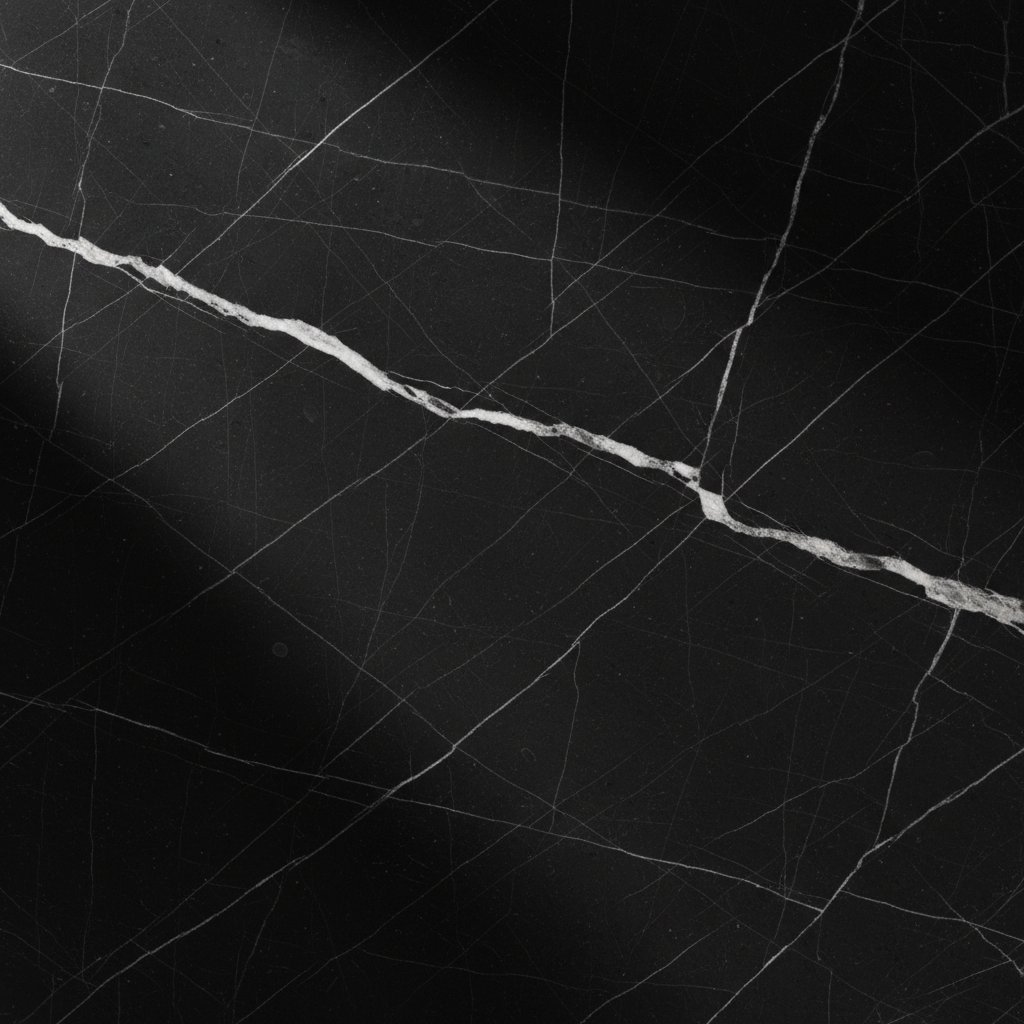
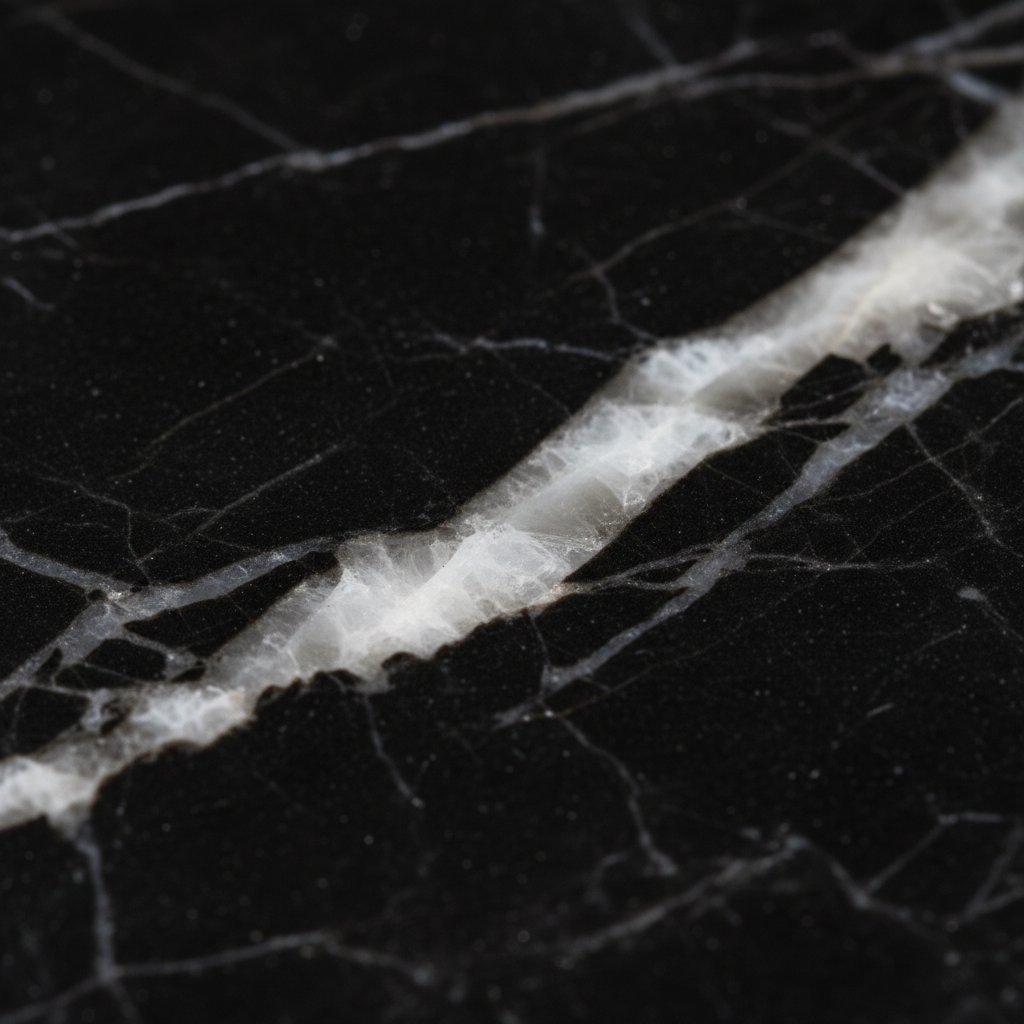
Vein density and direction matter for spec purposes. The Marquina Negro Standard grade has visible veining throughout the slab, often clustered in primary directions with finer secondary veins at angles. The Extra grade has sparser, more isolated veining, useful for projects where the stone is meant to read as a near-uniform dark field. The Veta grade has dense, dramatic veining for hero applications where the stone is meant to assert itself.
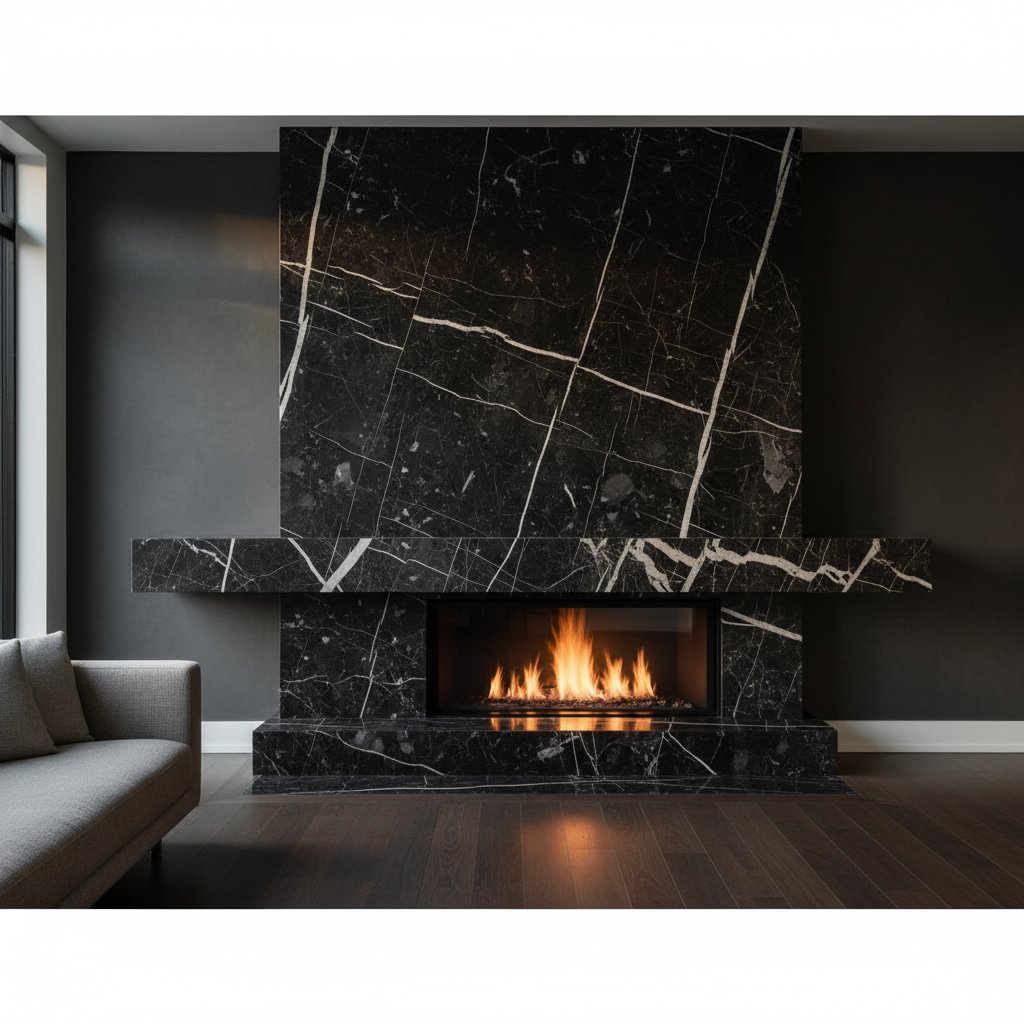
For larger installations (a kitchen island, a full-wall fireplace surround, a wall of cladding), bookmatching matters as much with Nero Marquina as it does with the Calacatta family, but in a different way. Bookmatched white veining across a dark field creates striking symmetrical compositions that read graphically. The technique is most often used in commercial hospitality work where the stone is meant to be a focal architectural moment.
Polished Drama, Honed Restraint, Leathered Touch
Nero Marquina accepts the same four finishes as the Italian marbles, and finish choice changes the stone's character more dramatically than for any lighter marble.
Polished brings the stone to its full near-black depth and maximises the contrast between the field and the white veining. Polished Nero Marquina reflects light back in a way that few materials match; in a well-lit room it reads as a reflective surface that doubles the apparent depth of the space. The finish shows fingerprints, water spots, and acid etches more visibly than any other Nero Marquina finish, but the visual impact is the trade.
Honed takes the stone to a soft matte finish. The black field reads as a deep charcoal rather than a true black; the white veining recedes from sharp lines into softer ghostly traces. Honed Nero Marquina is a different material visually from polished; designers often specify both finishes in different parts of the same room (a polished hero element, a honed surrounding floor) to play the contrast.
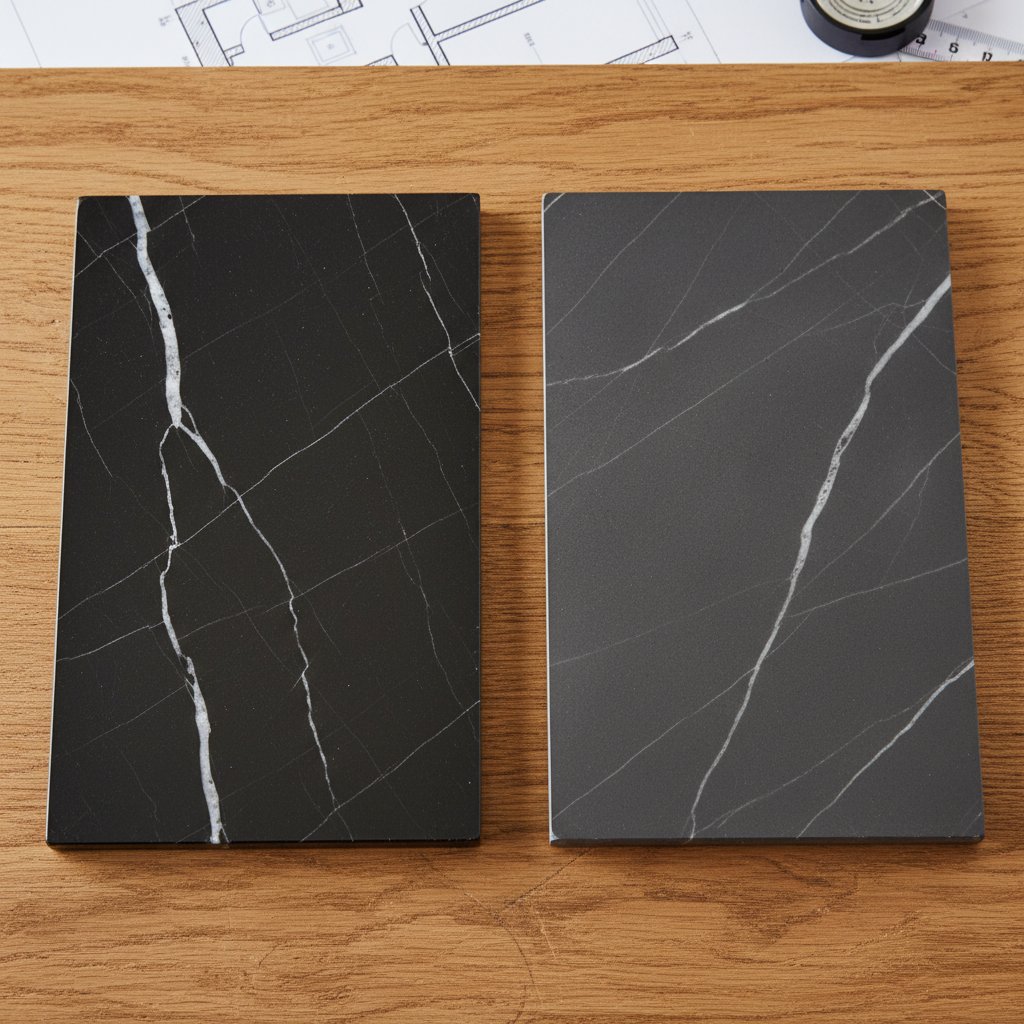
Leathered is where Nero Marquina becomes special. The diamond-brushed finish creates a tactile texture that reads as a soft topographic landscape under fingertips. On a dark stone, the texture catches and releases light differently than on a light stone, creating subtle highlights along the brushed grain that animate the surface. Leathered Nero Marquina is the contemporary specification of choice for kitchen islands and bathroom counters where the touch quality of the stone is part of the experience.
Brushed is similar to leathered with a more pronounced texture. Used mostly for exterior or industrial-luxury applications. Less common in fine residential.
The Forgiving Black
Nero Marquina is calcium carbonate, which means the same etching-from-acid issue that affects all the marbles in the Stone Library applies here too. Lemon, vinegar, wine, tomato, and acidic cleaners all etch the surface. What changes with a dark stone is how the etches read.
On a polished black surface, an etch reads as a dull spot against the polish. The contrast is visible but less dramatic than on a polished light stone, where the etch becomes a frosted patch against a mirror-like field. On honed Nero Marquina, etches barely register at all because the surface already reads as soft. On leathered Nero Marquina, etches almost disappear into the texture. For active kitchens and bath spaces where some etching is inevitable, the dark stone in honed or leathered finish is meaningfully more forgiving than any light stone.
Nero Marquina works in:
- Kitchens. Particularly in honed or leathered finish on islands and counters. The dark field hides crumbs, water spots, and minor staining better than light stones.
- Bath vanities, sinks, freestanding bathtubs. Polished for drama, honed for everyday calm.
- Cased openings, fireplace surrounds, door surrounds. The dark stone as architectural punctuation against lighter wall finishes.
- Wall cladding. For dramatic single-material walls in entries, stairwells, and feature rooms.
- Floors. Particularly in commercial and hospitality applications. The dark stone hides wear from foot traffic better than light marbles.
It does not belong on:
- Outdoor applications in Toronto. The freeze-thaw cycle is hostile to calcium carbonate stones in northern climates. The stone fractures over multiple winters as water freezes in micro-pores.
- Exterior cladding in any climate with significant temperature swing. Same logic.
- Commercial spaces with uncontrolled traffic. The stone shows scratches from grit dragged across the surface, which is less of a concern in residential contexts but matters in retail and high-volume hospitality.
Sealing. Nero Marquina should be sealed at fabrication and re-sealed every twelve to eighteen months. The penetrating sealer is particularly important for the dark stone, which can develop a slightly dusty appearance if dried-on water deposits accumulate on an unsealed surface. Pietra applies sealer at the shop and provides re-sealing instructions on delivery.
Pricing. Pietra pricing varies by stone grade, profile complexity, and project scope. Send your project for a firm quote within one business day.
What Nero Marquina Wants Next To It
Nero Marquina pairs strongest with materials that contrast its darkness rather than echo it. The most successful combinations introduce warmth, texture, or brightness against the cool architectural depth of the black field.
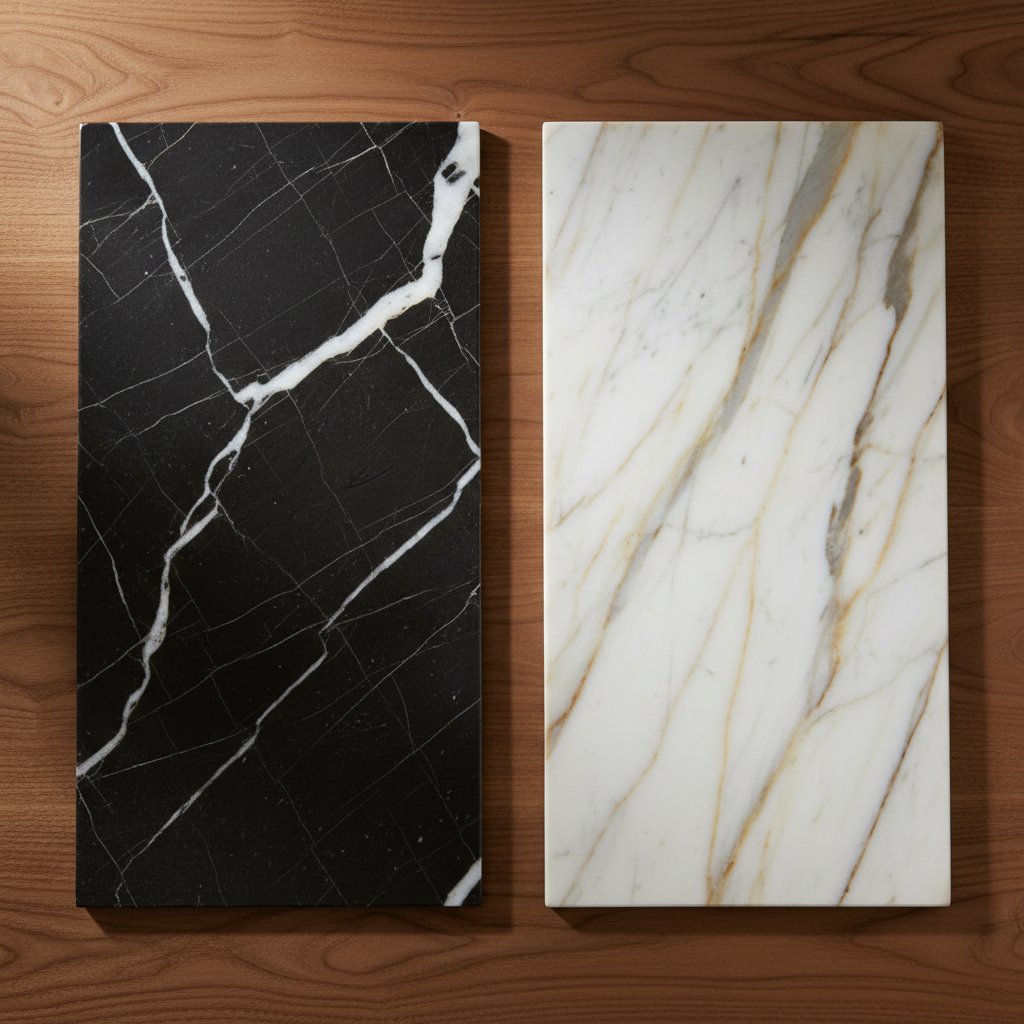
Calacatta Gold. The strongest contemporary pairing for Nero Marquina. The two stones read as inversions of each other: dark field with light veining versus light field with warm veining. Most often specified as a Nero Marquina island against a Calacatta Gold backsplash, or a Calacatta Gold vanity against a Nero Marquina floor. The contrast is dramatic but balanced because the veining patterns are complementary in scale and energy.
Carrara White. A quieter version of the Calacatta pairing. The cool white field of Carrara provides enough contrast against Nero Marquina to register without overwhelming the room. Useful when the design intent is more architectural and less dramatic.
Brushed brass and aged bronze. The warm gold tones of brass and bronze sit beautifully against the cool black of Nero Marquina. The combination is the foundational palette of a particular flavour of contemporary luxury (think Joseph Dirand's Paris apartments). Brass faucets, brass cabinet hardware, brass picture lights, brass switch plates: all read intentional against polished or honed Nero Marquina.
Materials Nero Marquina always works with
- Warm woods, particularly walnut and smoked oak. Dark wood tones provide tonal continuity with the dark stone; the wood grain provides texture against the stone's polish.
- White-painted millwork and trim. The crisp white reads as a deliberate counterpoint to the black stone.
- Plastered walls in warm cream or putty tones. The matte plaster softens the architectural read of the polished stone.
- Polished concrete in mid-to-dark tones. Continues the architectural language of the stone in a different material register.
What to be careful with
Nero Marquina should not be paired with other heavily veined dark stones unless the pairing is deliberately maximalist. Pairing Nero Marquina with Sahara Noir, Saint Laurent, or Portoro tends to produce visual chaos because the stones compete for the same role in the composition. The dark stone is itself the statement; what it needs around it is contrast, not echo.
For the bath
For a Nero Marquina vanity in a powder room or primary bath, the surrounding palette wants to lean warm. Brushed brass faucets, oak or walnut wall panelling, warm-tone plaster, brass picture lights. The cool dark stone needs warm partners; pairing it with cool greys and chrome tends to produce a clinical reading rather than a luxury one.