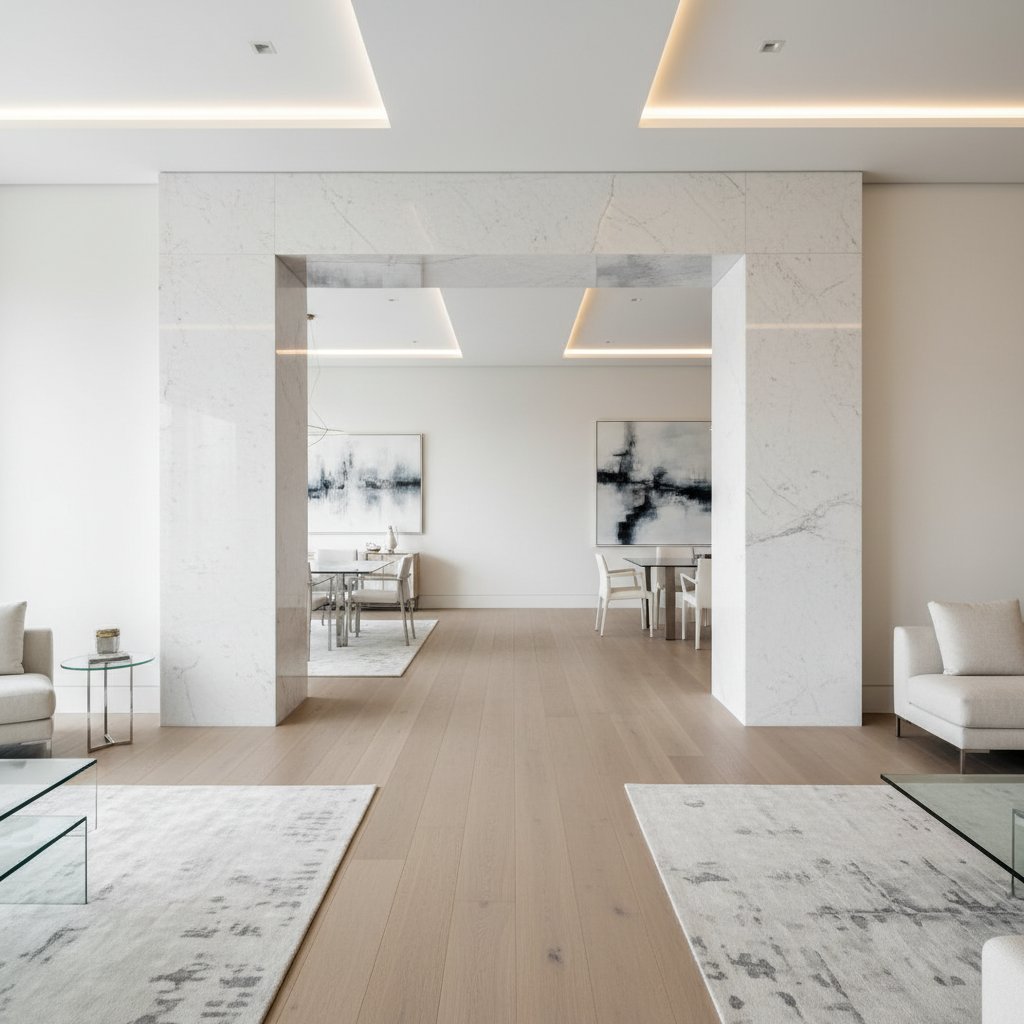
A Single Island in the Northern Aegean
Thassos is an island in the northern Aegean Sea, just off the coast of Macedonia. The marble is quarried from the highlands above the village of Saliara on the island's northeast side. It is a dolomitic marble, which is what gives it its uncommon brightness. Most white marbles are calcium carbonate, but Thassos is calcium magnesium carbonate, and the magnesium component refracts light differently. The result is a stone that reads almost luminous in person.
The geology is Precambrian, which makes Thassos one of the oldest commercial marbles in the world. The deposits formed more than 540 million years ago, before any of the famous Italian beds. The metamorphism that produced the stone happened deep underground at temperatures and pressures that recrystallised every grain into a uniform, fine-textured field.
- Origin: Thassos island, Greece
- Composition: Dolomitic marble (calcium magnesium carbonate)
- Tone: Brilliant pure white, almost luminous
- Veining: Minimal to none, near-uniform field
- Quarry age: Worked since circa 1000 BCE
Two Thousand Years of Use
Thassos was prized in antiquity for the same reason it is prized now. The ancient Greeks used it in temples on the island itself, and Roman builders shipped slabs across the empire when they wanted a marble that read whiter than any of the local quarries could produce. Sections of the Forum at Rome were faced in Thassos.
The quarry essentially went dormant after the fall of the Western Roman Empire and was rediscovered in the modern era. Today the island's production is controlled by a small number of operators, and the stone is exported worldwide. It is the white that designers reach for when Carrara feels too grey and Statuario feels too patterned.
Ancient Rome to Contemporary Luxury Hospitality
Thassos appears in the Forum at Rome, where Roman builders specified it for its unmatched brightness. The ancient Greeks used it in temple sanctuaries on the island itself, and throughout antiquity it was shipped across the Mediterranean for commissions where nothing else would read as luminous. After a long dormancy following the fall of the Western Empire, the stone re-entered use in the modern era and has become a standard specification among luxury hospitality designers.
In contemporary practice, the stone is most famously used by hospitality interior architects who rely on its photogenic purity for lobby floors and spa environments. High-end hotel chains across Greece, Turkey, and the Mediterranean favour Thassos for bathroom suites and flooring where the goal is visual cleanliness under varied lighting conditions. The stone's association with the Aegean has also made it the reference marble for resort environments that want to evoke Greek island light.
Among living interior architects, Thassos appears regularly in the work of designers working in minimalist luxury: the stone appeals to those who want a material backdrop that reads as pure field rather than as pattern. It is increasingly specified in contemporary London and New York residential interiors, particularly in master bathroom suites where the dolomitic brightness reads as a luxurious anchor. In Toronto, studio designers favour it for powder rooms and spa-inspired bathrooms where the material's luminosity becomes the primary design feature.
The stone has also gained traction in contemporary sculpture and fine art installations, where its brightness and lack of veining read as a blank slate for three-dimensional form. A number of contemporary artists working in minimalism have used polished Thassos slabs as backdrops or integrated sculptural elements.
Reading the Slab
What you notice about Thassos in person is that it has almost no visual texture. Most marbles read as patterns of veining over a base colour. Thassos reads as a single field. Slabs vary subtly from very slightly warm to very slightly cool, but the variation is small enough that book-matched pairs are usually unnecessary.
The fine grain catches light at the surface in a way that gives the stone a very faint sparkle, particularly when polished. This is the dolomitic crystal structure refracting light at the micro-scale. It reads as luminosity rather than glitter.
Polished, Honed, Leathered
Polished Thassos is the most common specification. The polish brings out the dolomitic luminosity and reads as brilliant. Honed Thassos reads softer and slightly warmer because the matte surface scatters light rather than reflecting it. Leathered Thassos is rare but produces a pleasant tactile surface that masks the inevitable etching that comes with use over decades.
One specific note: dolomitic marbles like Thassos are slightly harder than calcite marbles like Carrara. They take a sharper polish and hold edges better. The trade-off is that they are more brittle, so honed and leathered finishes can show small chips on edges and corners more visibly than polished does.
Living With Thassos
Thassos is dolomitic, which means it is more resistant to acid etching than calcite marbles, but not immune. Lemon juice and vinegar will still leave dull spots if left in contact with the surface for more than a few minutes. We recommend Thassos primarily for bathrooms, fireplace surrounds, archway casings, and feature walls. We are cautious about specifying it as a kitchen counter unless the client is prepared to maintain it carefully.
Sealing should be done at installation and refreshed every two to three years. The dolomitic surface accepts sealer well but the brilliance of the stone makes any sealer film visible, so application requires a careful hand.
What Goes With Thassos
The brightness of Thassos pairs well with warm metals. Unlacquered brass, antique brass, and brushed bronze all read beautifully against the white field. Polished chrome reads cold next to Thassos and we generally steer clients away from it.
For wood, the stone reads at its best with mid-tone walnut or rift-cut white oak. Very dark woods (wenge, ebonised oak) create a strong contrast that some clients want and others find too graphic. Very pale woods (white-washed oak, maple) read soft against Thassos and produce a quieter scheme.