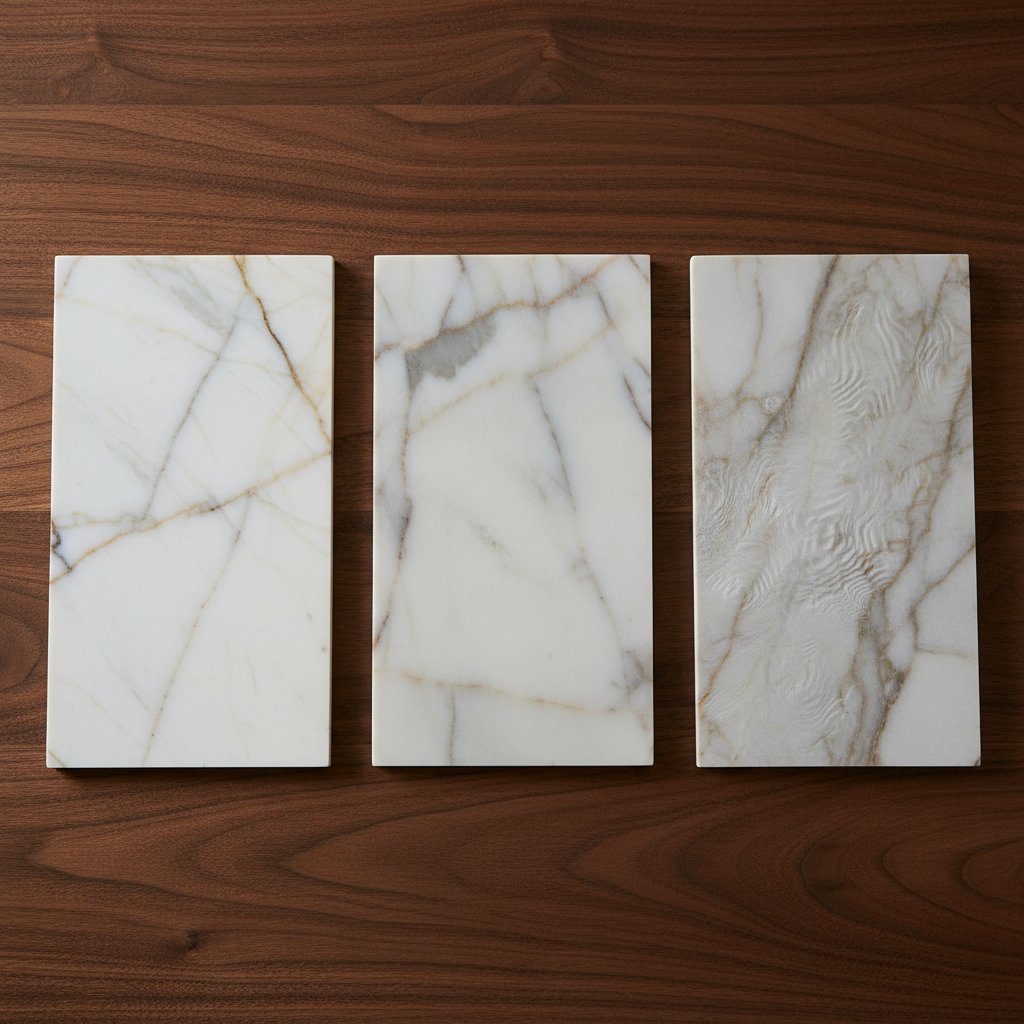
The Mechanics of the Three Finishes
The finish is the surface treatment applied to the stone after fabrication. The same block of Calacatta Gold can be brought to any of three primary finishes (polished, honed, leathered) using progressively different mechanical processes. Understanding what each process actually does to the stone surface is the foundation for understanding how each finish reads in a room.
Polished is the highest-energy mechanical surface treatment. The stone is ground with progressively finer abrasives (60 grit, 120 grit, 220 grit, 400 grit, 800 grit, 1500 grit, 3000 grit, and finally a polishing pad) until the surface achieves mirror-like reflectivity. The polishing process compresses the surface micro-structure of the stone, producing a glossy finish that reflects light at high specular intensity. Polished is the traditional luxury marble finish; it has been the default for monumental architectural stone since Roman times.
Honed takes the same grinding process but stops at an earlier grit (typically around 400 grit). The surface is smooth but not reflective; light reads off it as soft matte rather than mirror gloss. Honed is the contemporary luxury default for residential applications; the matte character pairs more naturally with the warm woods, plastered walls, and brushed metals of contemporary interiors than the more clinical polished finish.
Leathered is a fundamentally different surface treatment. After the stone is honed, it is treated with diamond-tipped brushes that follow the natural grain of the stone, creating a soft, subtly undulating surface texture. The brushing process catches light along the grain direction in ways smooth surfaces do not, producing a surface that reads as both matte and tactilely rich.
How Light Reads Off Each Finish
The single biggest difference between the three finishes is how they handle light. The same room with the same stone in three different finishes is three visually different rooms.
| Property | Polished | Honed | Leathered |
|---|---|---|---|
| Light reflectivity | Very high (mirror) | Low (matte) | Very low (textural) |
| Veining contrast | Maximum | Softened | Subtle |
| Apparent colour saturation | Highest | Moderate | Lowest |
| Touch character | Smooth, slick | Smooth, soft | Tactile, ridged |
| Apparent thickness | Less (light reflects through) | True | More (texture adds depth) |
Polished brings everything in the stone to maximum visibility. The veining contrast is sharpest, the colours read at their most saturated, and the surface reflects everything around it (light fixtures, ceiling beams, the colour of the walls). In a well-lit room with good architecture, polished is luminous. In a poorly lit room, polished can read as cold and clinical because the reflections become the dominant visual element.
Honed calms the entire visual register. The veining recedes from sharp lines into softer gestures. The colour saturation drops perhaps 15 to 20 percent (a polished Verde Guatemala reads as deep green; a honed Verde Guatemala reads as warm grey-green). The surface no longer reflects the surrounding room, which means the stone reads as itself rather than as a mirror.
Leathered shifts the stone into a different visual category entirely. The texture catches light along the grain direction, creating subtle highlights that animate the surface as the viewing angle changes. The finish reads as more tactile and material than either polished or honed; you want to touch leathered stone in a way you don't want to touch polished.
Etching, Fingerprints, and Cleanability
The three finishes have meaningfully different practical performance even on the same stone. For calcium carbonate marbles (the great majority of luxury stones in the Pietra catalogue) these differences matter most.
Etching visibility. Acid etching from lemon, vinegar, wine, or tomato produces a permanent matte spot on the polished surface. On polished stone, the etch is highly visible because it reads as dull against the reflective surrounding surface. On honed stone, the etch is much less visible because the surrounding surface is already matte. On leathered stone, etching is barely visible at all because the textural character of the surface masks the surface roughness change. For active kitchens or family bathrooms where some etching is inevitable, honed and leathered finishes are dramatically more forgiving than polished.
Fingerprints and water spots. Polished surfaces show fingerprints and water spots aggressively because the high-reflectivity surface is unforgiving. Honed surfaces hide fingerprints almost entirely. Leathered surfaces hide them completely.
Scratching. All three finishes scratch from harder materials, but the scratch shows differently on each. On polished stone, a scratch reads as a matte streak against the reflective surface. On honed stone, the scratch is much less visible. On leathered stone, the scratch typically disappears into the existing texture.
Cleaning. All three finishes clean similarly with neutral pH stone cleaner and a soft cloth. The leathered finish requires slightly more attention to crevices in the texture; food particles can accumulate in the textural valleys if not cleaned regularly.
Recommendations by Application
Kitchen counters
Honed for active cooking households. The matte surface hides etching, fingerprints, and minor scratches that polished would show dramatically. Leathered as the more sculptural alternative for buyers who want the textural character. Polished only for buyers who actively want the patina that comes from etching as part of the material's life.
Bath vanities
Polished for powder rooms and infrequently-used guest baths where the stone is meant to be the visual statement and exposure is minimal. Honed for primary baths where daily use makes the etching forgiveness valuable. Leathered as the contemporary alternative for projects that want the textural character.
Bathtubs
Honed almost always. A polished marble tub shows water spots aggressively after every use. The honed surface is forgiving and reads as warmer. Leathered tubs are rare but appropriate for very contemporary or sculptural projects.
Cased openings, door surrounds, fireplace surrounds
Polished for traditional and formal projects where the stone is the dramatic focal element and the reflection adds to its visual presence. Honed for contemporary projects where the architectural restraint is the design intent.
Wall cladding
Honed as the contemporary architectural default. Polished cladding can read as overly reflective in large installations. Leathered for projects that want the texture to animate the surface across an entire wall.
Floors
Honed for residential floors. Polished marble floors can be slippery when wet; honed has better traction and shows wear less aggressively. Leathered is rare on floors but valuable in specific architectural projects.
The Decision Process
Three questions to answer before specifying a finish:
One: How is the room lit? Polished marble needs good light to perform; in dim rooms it reads as cold and clinical. Honed and leathered both work in any light condition. If you have a dramatically lit room with good natural light, polished is the strongest choice. If lighting is more restrained, default to honed.
Two: How will the stone be used? If the surface will see daily acid exposure (active kitchen counter, busy bath vanity), honed or leathered will dramatically outperform polished over a 10-year horizon. If the stone is essentially decorative (cased opening, wall cladding, fireplace surround), polished gets to be polished without practical penalty.
Three: What aesthetic are you committing to? Polished reads as traditional luxury, formal, classical. Honed reads as contemporary luxury, architectural, restrained. Leathered reads as contemporary craft, tactile, slightly rustic. The three finishes communicate different design intents even before the stone choice itself enters the conversation.
For most contemporary residential projects in our catalogue, the default specification is honed. This pairs naturally with the warm wood, plastered wall, brushed metal palette of contemporary luxury and forgives the practical realities of how families actually use their homes. Polished and leathered remain valuable for specific applications where their character serves the design intent, but honed is the workhorse.