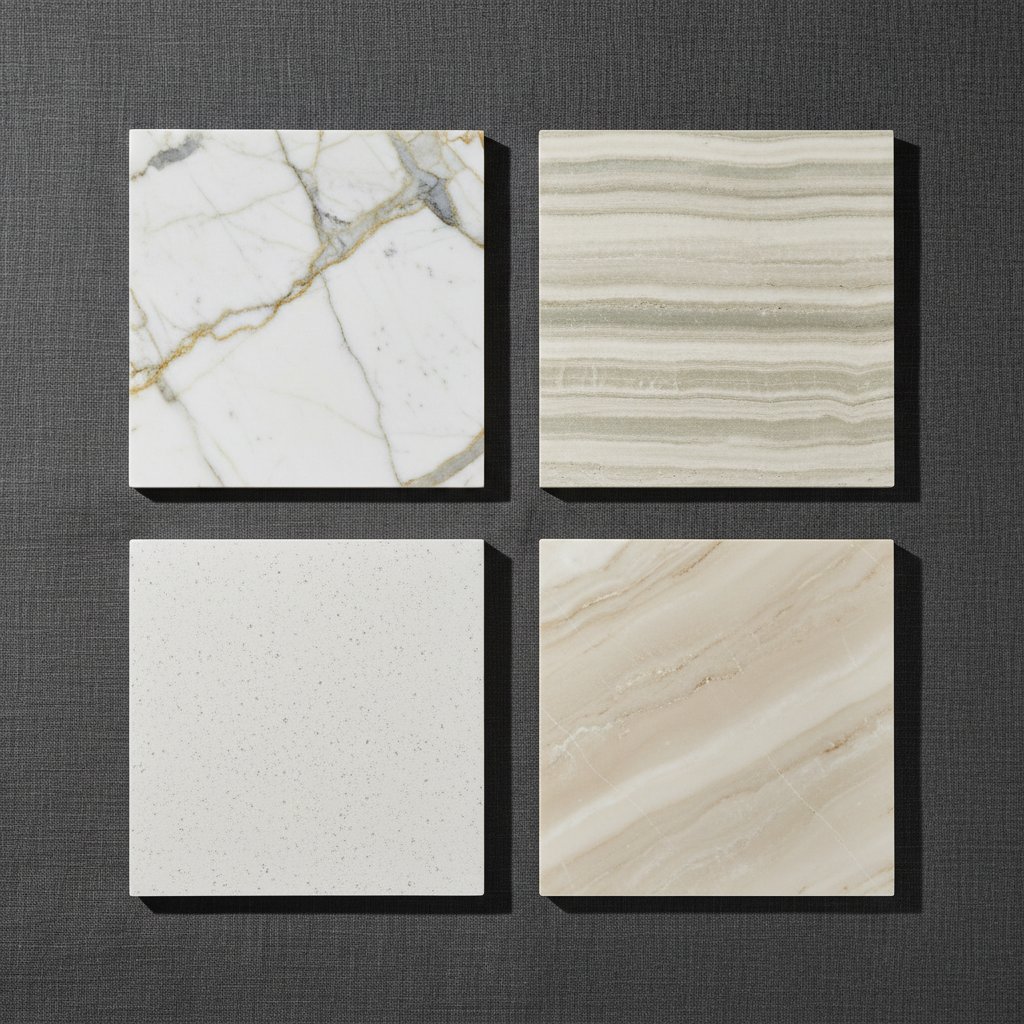
What Each Material Actually Is
Before any comparison can be useful, the four materials need to be defined honestly. Trade names blur the categories, marketing material conflates them, and the result is that buyers often choose the wrong material because they don't know what they're choosing.
Marble is a metamorphic rock formed when limestone is subjected to pressure and heat. It is calcium carbonate. It is a natural stone quarried from specific geological formations: the Apuan Alps in Italy (Carrara, Calacatta, Statuario), the Basque Country (Nero Marquina), Tunisia (Sahara Noir), Spain (Emperador Dark, Crema Marfil). Each named marble is a specific quarry source with specific visual character. The four-billion-dollar global marble market trades these named stones as commodities with significant grade variation.
Quartzite is also a metamorphic rock, formed when sandstone is subjected to pressure and heat. It is silicon dioxide (quartz) bonded by additional silica deposited during metamorphism. Quartzite is significantly harder than marble (Mohs 7 versus Mohs 3-4) and resistant to acid etching. The category includes Macaubas, Taj Mahal, Cristallo, and Patagonia, among others. Quartzite is sometimes mislabelled as marble in the trade because the visual character can be similar.
Quartz is engineered stone, not natural stone. It is roughly 90 percent ground natural quartz mineral combined with polymer resins, pigments, and binders, then formed into uniform slabs. Brand names include Caesarstone, Silestone, Cambria, Vicostone, Pental Quartz. The material is engineered to be uniform, non-porous, and consistently coloured, which makes it predictable in ways natural stone is not.
Porcelain is fired ceramic, manufactured from clay and silica fired at very high temperatures. The category includes large-format porcelain slabs marketed for counters and walls (brands include Neolith, Dekton, Laminam, Inalco, Florim Stone). Porcelain is non-porous and extremely hard, with the visual character produced by digital printing on the surface during manufacturing.
How Each Material Holds Up
Durability is the question that drives most kitchen counter decisions, and the differences between the four materials are meaningful.
| Property | Marble | Quartzite | Quartz | Porcelain |
|---|---|---|---|---|
| Hardness (Mohs) | 3-4 | 7 | 7 | 7-8 |
| Acid etching | Yes (significant) | No | No | No |
| Scratching | Easily | Resistant | Resistant | Highly resistant |
| Heat resistance | Moderate | High | Low (resin damage) | Very high |
| Staining (porous) | High; needs sealing | Moderate; needs sealing | None (non-porous) | None (non-porous) |
| UV stability outdoors | Stable | Stable | Resin can yellow | Stable |
Acid etching is the single most important property for kitchen counter decisions. Marble is calcium carbonate; lemon juice, vinegar, wine, tomato sauce, and acidic cleaners react with the calcium carbonate to create permanent matte spots in the polished or honed surface. Quartzite, quartz, and porcelain do not etch from typical kitchen acids.
Scratching is the second most important property. Marble at Mohs 3-4 will scratch from steel knives, dropped ceramics, and gritty surfaces. Quartzite at Mohs 7 is harder than steel; it will not scratch from typical kitchen use. Quartz and porcelain similarly resist scratching.
Heat resistance matters more than most buyers realise. Quartz contains polymer resin binders that begin to degrade above 300°F. A hot pan placed directly on quartz can cause permanent discolouration or cracking. Marble, quartzite, and porcelain are all natural materials (or fired ceramic) that handle high heat without damage. The trade-off for quartz's other advantages is heat sensitivity.
Staining is a porosity question. Marble and quartzite are porous and absorb liquids if unsealed; sealing is required and reduces but does not eliminate staining risk. Quartz and porcelain are non-porous and do not stain regardless of sealing.
Authenticity, Variation, and Pattern
Visual character is where marble holds an irreducible advantage and where the engineered alternatives most strenuously try to compete. The honest answer is that no engineered material truly looks like real marble at close range, but the engineered alternatives have closed the gap meaningfully.
Marble has the visual character of geological formation: veining flows in patterns determined by mineral deposition along fault lines over hundreds of millions of years. No two slabs of Calacatta Gold are identical; the variation between blocks within a named category is significant. The veining has depth (it goes into the stone, not just on the surface) and changes its visual character with the angle of light and the time of day. This is what natural stone looks like; nothing else looks the same.
Quartzite has natural variation similar to marble but in a different visual register. The veining is generally subtler than dramatic marbles like Calacatta Gold; the colours tend toward whites, greys, and warm beiges with occasional dramatic exceptions like Cristallo or Patagonia. Quartzite often gets mislabelled as marble because the white-and-grey varieties read similarly at first glance, but the texture and veining pattern are distinguishable to a trained eye.
Quartz is engineered for uniformity. Early generations of quartz had a characteristic uniform speckle that read as engineered immediately. Current generation quartz includes marble-look products with simulated veining (Caesarstone Calacatta Maximus, Silestone Eternal, Cambria Brittanicca) that read more like real marble at distance but reveal their engineered character at close range: the veining is two-dimensional rather than depth-dimensional, the pattern repeats across slabs, and the surface has a uniform reflectivity that natural stone does not.
Porcelain has come furthest in marble-look authenticity over the past five years. Large-format porcelain slabs (Neolith, Dekton, Laminam) use high-resolution digital printing to reproduce the appearance of marble veining with remarkable fidelity. At distance, premium porcelain marble-look slabs are difficult to distinguish from real marble. At close range and from oblique angles, the printed surface reveals itself: the veining is on the surface only, the pattern often repeats across slabs from the same production run, and the touch character is ceramic rather than stone.
Real Numbers Across the Four Materials
Cost varies enormously within each category based on grade, brand, complexity, and installation. The figures below are 2026 wholesale slab pricing in CAD per square foot, with installation cost ranges typical for the GTA.
| Material | Slab cost (CAD/sqft) | Installed cost (typical kitchen) | Lifetime maintenance |
|---|---|---|---|
| Carrara White marble | pricing on request-80 | pricing on request-15,000 | Sealing every 1-2 years; potential refinishing |
| Calacatta Gold marble | pricing on request-150 (premium pricing on request+) | pricing on request-30,000 | Sealing every 1-2 years; etching expected |
| Quartzite (mid-grade) | pricing on request-140 | pricing on request-22,000 | Sealing every 2-3 years; minimal otherwise |
| Quartz (premium) | pricing on request-110 | pricing on request-18,000 | None required |
| Large-format porcelain | pricing on request-130 | pricing on request-22,000 | None required |
Several patterns are worth noting. Marble has the widest price range (a Carrara kitchen at the low end can cost less than a quartz kitchen at the premium end; a Calacatta Gold kitchen at the high end can cost three times either alternative). Quartzite is consistently in the same price band as mid-grade marble. Quartz and porcelain are often comparable to each other and slightly less expensive than equivalent natural stone.
The lifetime maintenance column matters more than buyers usually consider. A Carrara kitchen will need re-sealing every 12 to 18 months (a few hundred dollars and an hour of work) and may need professional refinishing once or twice over a 20-year ownership (a few thousand dollars). A quartz or porcelain kitchen has effectively zero maintenance cost.
Which Material Belongs Where
The right material depends on the application. Here is the honest recommendation by application:
Active kitchen counters with serious cooking
Quartzite if you want natural stone with the visual character of marble but without the etching concern. Quartz if you want the predictability and zero-maintenance of an engineered material. Porcelain if you want the marble look at lower cost than real marble. Marble is possible but only for buyers who actively want the patina that comes from etching and don't mind professional re-finishing every five to ten years.
Powder rooms and primary bath vanities
Marble is the right answer. The exposure to acidic substances is minimal (powder rooms see soap, water, occasionally hand cream); the visual character of real marble is hard to match in any engineered material; the lifetime maintenance is low because the etching risk is so much lower than in a kitchen. Pietra fabricates the great majority of our Bath work in marble for this reason.
Cased openings, fireplace surrounds, door surrounds
Marble almost always. These are architectural elements with no functional surface contact, no acid exposure, and a visual character that demands the depth and authenticity of natural stone. Porcelain large-format slabs can work in budget-conscious projects but the engineered character reads at any visible distance.
Wall cladding
Marble for premium projects where the depth and variation matter. Porcelain for projects with budget constraints or for installations where the cladding needs to be lightweight (porcelain at 12mm is much lighter than marble at the same thickness). Quartzite rarely; the slab sizes available are usually too small for major cladding installations.
High-traffic floors
Quartzite for natural stone with maximum durability. Porcelain for engineered durability at lower cost. Marble works in formal low-traffic floors (entries, formal dining rooms) but shows wear in high-traffic locations.
How We Specify
Pietra fabricates almost exclusively in natural stone, primarily marble, with selective use of quartzite for clients who want stone but need higher durability than calcium carbonate marbles offer. We do not fabricate in quartz or porcelain. The reason is editorial rather than technical: our work is built around the depth, variation, and craft tradition of natural stone, and the engineered alternatives serve different design goals.
For most of our clients the right specification is:
- Marble for vanities, surrounds, fireplaces, and cladding. The lifetime maintenance trade is real but small in these applications.
- Marble for kitchen counters in homes where the buyer actively wants natural stone and accepts patina as part of the material's character. Many of our most design-literate clients specify Calacatta Gold or Verde Guatemala kitchens with full understanding of what that means.
- Quartzite for kitchens where natural stone is non-negotiable but the buyer wants no etching concern. We work with quartzite specialists for this work.
- Quartz or porcelain we recommend other fabricators. These materials serve different buyers and different design goals than we are organised to deliver.
Quick decision guide
- You want the visual character of real marble and accept some patina: marble
- You want the visual character of real stone with no etching concern: quartzite
- You want maximum predictability and zero maintenance: quartz
- You want the marble look at lower cost or in lightweight cladding: porcelain
The wrong choice in this category usually comes from buyers who specify marble for hard-use kitchens because they want the look, then are surprised by the etching; or who specify quartz for primary bath vanities because they want the durability, then are surprised that the engineered uniformity reads as the wrong material in a luxury bath context. Decide what the room is actually about, then choose the material that serves that intent.