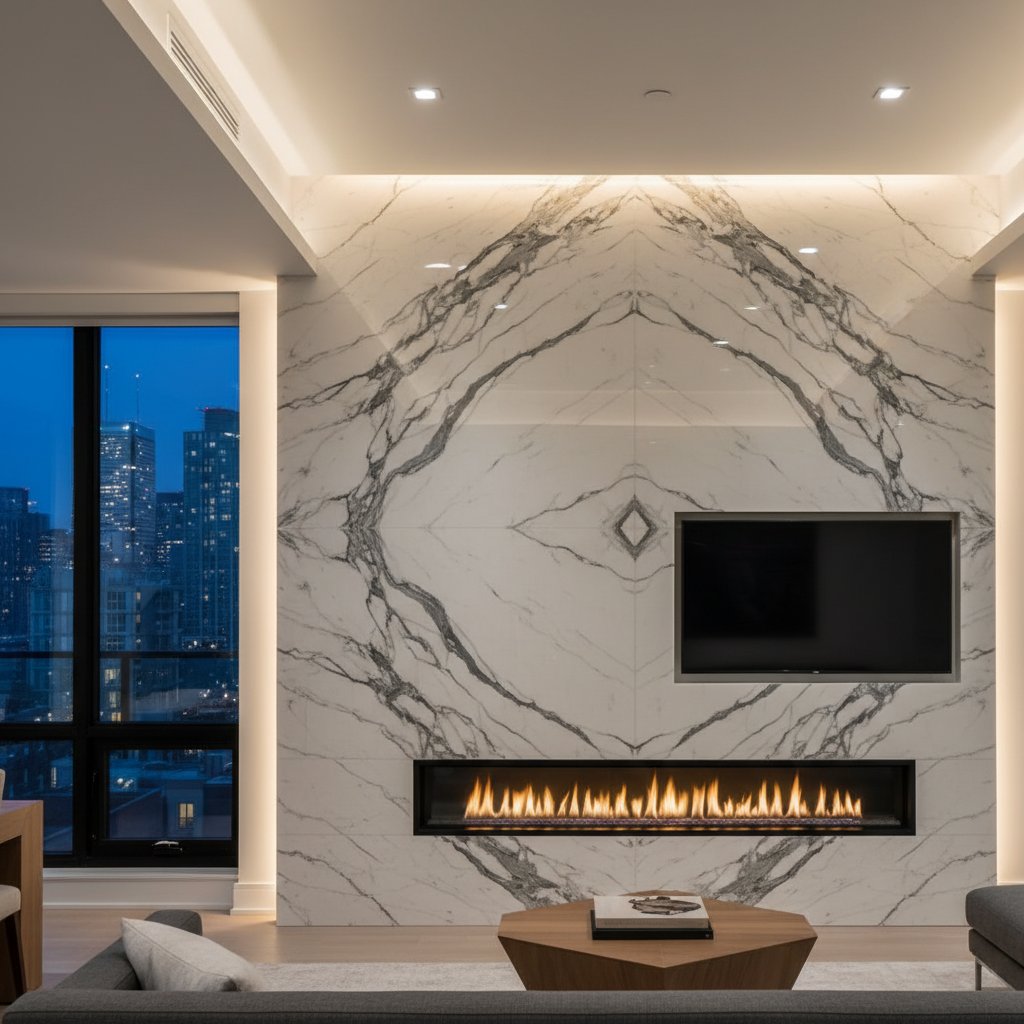
The Apuan Alps Above Carrara
Arabescato is quarried in the Apuan Alps above Carrara, Italy, in the same general region as Statuario and Calacatta. The two best-known commercial varieties are Arabescato Vagli and Arabescato Cervaiole, named for the specific quarry zones they come from. Both share the characteristic bold curving veining, though the exact pattern varies slab to slab.
The geology is the same Jurassic limestone metamorphism that produced Carrara, Statuario, and Calacatta. What makes Arabescato distinct is the way the iron and graphite impurities concentrated during metamorphism. They formed thicker, more curved bands rather than the thin linear ones that produce Statuario's graphic look or the wispy ones that produce Carrara's soft look.
- Origin: Apuan Alps, Carrara, Italy
- Composition: Calcite marble
- Tone: Bright white field
- Veining: Bold curving dark grey arabesque patterns
- Famous varieties: Arabescato Vagli, Arabescato Cervaiole
The Renaissance Stone
Arabescato has been quarried since at least the Renaissance, when Tuscan sculptors used it for figural work and architectural elements. The name arabesco refers to the Arab-influenced ornamental tradition of curving plant and geometric forms in Islamic art, which is what the veining patterns suggest.
The stone was less used in classical Roman architecture than Carrara because the bold pattern competes with carved ornament rather than complementing it. Its modern popularity dates from the early twentieth century, when Italian and French interior designers began using it for floors and feature walls in luxury hotels and private residences.
Renaissance Figural Sculpture to Contemporary Luxury Retail
Arabescato has been quarried from the Carrara region since the Renaissance and appears in sculptural and architectural applications from that period onward. Its patterned veining made it less ideal than Statuario for figural sculpture, but it was widely used for decorative architectural elements, panels, and flooring in Renaissance palaces. The bold pattern that later designers would celebrate was, in the Renaissance context, acceptable rather than preferred.
The contemporary rehabilitation of Arabescato began with the rise of luxury retail in the late twentieth century. Bvlgari and Giorgio Armani both specified Arabescato for flagship store interiors, where the pattern's visual drama aligned with the brand's aesthetic of bold luxury. The stone's sculptural veining became an asset rather than a liability. Tadao Ando used Arabescato in several residential projects in Japan in the 1990s and 2000s, where the pattern read against his minimalist architecture as a counterweight and visual anchor.
In contemporary residential and hospitality design, Arabescato is the marble most associated with dramatic visual statement. High-end hotel chains have specified it for spa and lobby environments. Interior architects working in maximalist or contemporary classical styles favour it for its ability to command a room. The stone appears frequently in luxury penthouse interiors in major cities, particularly in master bathrooms and kitchen islands where a single dramatic gesture is desired.
In Toronto's residential market, Arabescato has become the stone of choice for designers working in contemporary maximalist interiors or in renovations of heritage homes where the bold pattern reads as a modern counterpoint to classical architecture. It appears regularly in the work of contemporary GTA interior designers working at the luxury residential level.
The Pattern That Curves
Arabescato's veining is the defining feature. Where Statuario veins run in linear bands and Carrara veins feather softly, Arabescato veins curve in painterly loops and arches. The pattern reads almost calligraphic, and slabs from the same block can produce wildly different visual compositions depending on how they are cut.
For any visible installation, we recommend choosing the specific slab in person and planning the cuts to make the most of the pattern. A vein that arcs across a continuous countertop reads as a single composition. The same vein interrupted by a cooktop or a sink cutout can read as broken. The art is in the layout.
Polished, Honed, Leathered
Polished Arabescato is the standard specification. The polish maximises the contrast between the bright white field and the dark grey veining, which is what most clients want from this stone. Honed Arabescato reads softer and slightly more grey overall, which can be a good choice when the design wants the pattern present but quieter. Leathered Arabescato is rare and creates an interesting tactile surface but mutes the contrast that defines the stone.
Living With Arabescato
Arabescato is a calcite marble. It will etch on contact with acids and stain if liquids are left to sit. The bold pattern actually helps disguise minor etching better than a quiet white would, because the eye is drawn to the veining rather than the field. For kitchen counters we recommend honed finish for clients who plan to cook regularly.
Sealing should be done at installation and refreshed every two to three years. We provide a written care guide with every Arabescato install.
What Goes With Arabescato
Arabescato has enough visual energy that it pairs best with quiet supporting materials. Solid white-painted millwork, rift-cut white oak, and matte black hardware all read well as supporting players. Polished nickel and aged brass both work for fixtures.
We avoid pairing Arabescato with another patterned material. Two competing patterns in the same room will exhaust the eye. If the kitchen has Arabescato on the island, the perimeter counters should be solid quartz or a very quiet honed limestone. The marble does the talking.