The Lasa Valley in South Tyrol
Bianco Lasa is quarried in the Lasa Valley in the autonomous province of South Tyrol in northern Italy. The valley sits in the Vinschgau region against the border with Switzerland and Austria. The marble has been worked since Roman times and is named for the village of Lasa at the valley's entrance.
Geologically, Lasa is a calcite marble that formed from limestone metamorphosed during the Alpine orogeny. Unlike the Carrara region where multiple impurities created strong veining, the Lasa marble formed from a particularly pure limestone in a relatively quiet metamorphic environment. The result is a stone that carries far fewer mineral inclusions than the typical Italian whites.
- Origin: Lasa Valley, South Tyrol, Italy
- Composition: Calcite marble, exceptionally pure
- Tone: Cool clean white
- Veining: Very minimal, often nearly absent
- Character: Quiet, modern, almost monochrome
The Modernist Marble
Lasa marble has a long association with modernist architecture. The Italian rationalist movement of the 1920s and 1930s favoured Lasa specifically because its quietness suited their aesthetic of clean lines and minimal ornament. Mussolini's public architecture used Lasa heavily for the same reason, and the stone has spent the decades since trying to outlive that association.
In contemporary architecture Lasa is the white marble of choice for projects where the architect wants natural stone but does not want the marble to be the visual subject. It appears in Tadao Ando's residential work and in numerous European museum and gallery interiors.
Italian Rationalism to Contemporary Minimalist Practice
Bianco Lasa gained prominence during the Italian Rationalist movement in the 1920s and 1930s, appearing in public buildings and institutional work designed under Mussolini's architectural patronage. The Rationalists favoured it for its austere purity and its lack of decorative pattern. The stone's quiet consistency read as politically and aesthetically modern. This historical association was rediscovered and reframed by contemporary minimalist architects in the late twentieth century.
The contemporary use of Lasa is defined by its adoption in minimalist architecture and the refined luxury retail sector. Tadao Ando has specified it repeatedly in residential and commercial projects in Japan and Europe, where its cool undertone and monochromatic field suit his aesthetic of spatial reduction to essentials. The stone appears in flagship retail stores and corporate headquarters across Europe, particularly in Milan, where Italian luxury brands favour it for its restraint and its association with Italian design tradition.
In the past two decades, Lasa has become the reference stone for architects and designers working in what might be called "quiet luxury" minimalism. High-end commercial interiors from Copenhagen to Barcelona feature Lasa in flooring, cladding, and feature walls. Private collections and contemporary art museums often specify it as a neutral backdrop that allows the collection to remain the focus. Swiss luxury architecture has embraced it as a material baseline.
In Canada, Lasa appears in the work of contemporary minimalist and modernist architects, particularly in Toronto and Vancouver. It has become increasingly popular among designers who want a pure white stone without the dramatic pattern associated with more expressive marbles. It is the marble for clients and architects committed to a philosophy of material restraint and visual clarity.
The Quiet Field
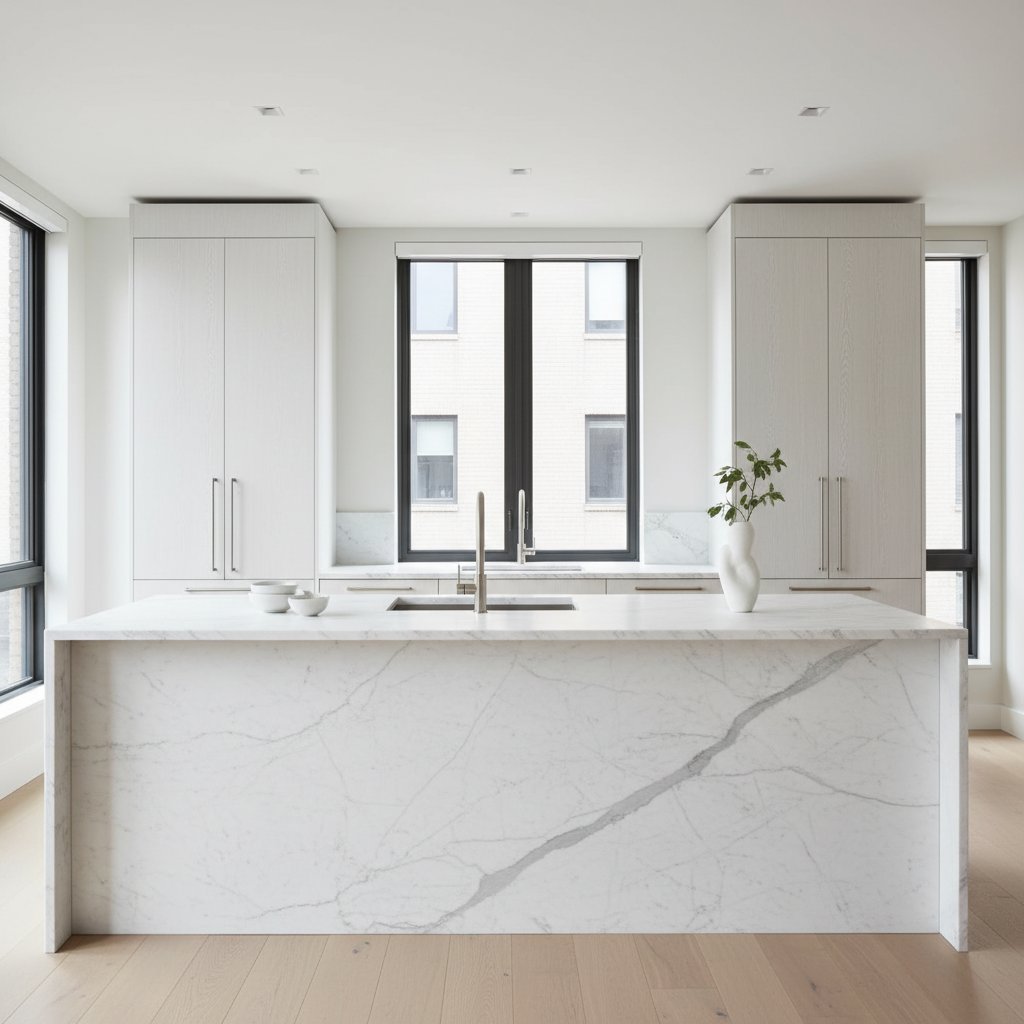
Lasa reads as nearly monochrome. There is some subtle variation in tone and very faint grey markings, but compared to Carrara, Statuario, or even Volakas, the field reads as essentially uniform. This is exactly what its admirers want from the stone.
The undertone is cool. Where Volakas reads slightly cream and Carrara reads soft grey, Lasa reads cool clean white with a very faint blue edge. Under bright daylight this reads as crisp. Under warm artificial light it warms up but never reads cream.
Polished, Honed, Leathered
Honed Lasa is the most-specified finish. The matte surface suits the stone's quiet character, and the slight softness pairs beautifully with the cool undertone. Polished Lasa is also common, particularly in commercial work, where the higher reflectivity suits a more formal reading. Leathered Lasa is uncommon but produces a pleasant tactile field with very subtle visual variation.
Living With Lasa
Lasa is a calcite marble and will etch on contact with acids. The minimal veining means etching is more visible on Lasa than on a strongly patterned marble like Arabescato, because there is less pattern to draw the eye away from any defect. For kitchen counters we recommend honed Lasa with a light leather option for clients who plan to cook seriously.
Sealing at installation and every two to three years thereafter is standard. The cool tone means sealer film is largely invisible, which makes sealing relatively forgiving on this stone.
What Goes With Lasa
Lasa is the marble for cool palettes. It pairs beautifully with rift-cut white oak in a clear or whitewashed finish, with brushed nickel and polished chrome fittings, and with cool greys in supporting tile or millwork. The stone reads particularly well in rooms with abundant natural light, where the cool undertone is amplified.
We avoid pairing Lasa with warm woods or aged brass. The undertone of the stone fights with warm tones, and the contrast can read as unintentional. If a project calls for a quiet white marble in a warm scheme, we usually recommend Volakas or Bianco Dolomite instead.