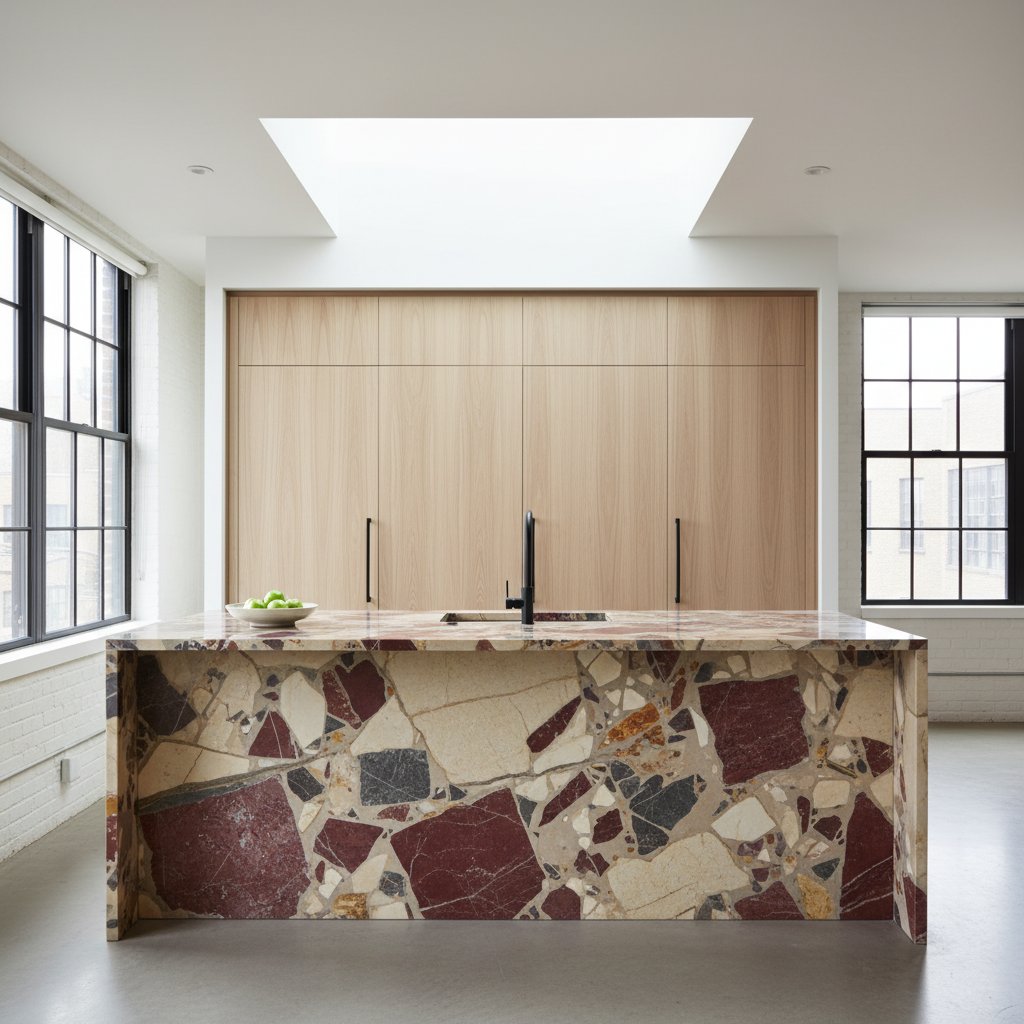
A Tuscan Breccia
Breccia Capraia is quarried in Tuscany, in the Apennine foothills. A breccia is a rock made of angular fragments of older rock that have been broken, rearranged, and bound together by a finer-grained matrix. Breccia Capraia formed when older limestones and marbles were fragmented by tectonic activity and recemented by calcite-rich fluids.
The varied colours of the fragments reflect the mix of source rocks: red and pink fragments are iron-stained limestones, grey fragments are darker carbonate rocks, cream fragments are paler limestones. The matrix between fragments is typically a darker calcite that binds the whole composition together.
- Origin: Tuscany, Italy
- Composition: Brecciated limestone marble
- Tones: Red, pink, grey, cream fragments in dark matrix
- Pattern: Angular brecciated, painterly variation
- Character: Bold, varied, conversational
The Italian Breccia Tradition
Brecciated marbles have been used in Italian architecture since Roman times. The variety and visual energy of breccia stones suited the polychrome aesthetic of imperial Roman and later Byzantine architecture, where contrasting marbles were inlaid in geometric and figural patterns. Breccia Capraia is part of this longer tradition and has been quarried since at least the Renaissance.
Modern use focuses on feature applications. The stone is rarely specified for large surfaces because the visual energy can become exhausting at scale. It works best as a single feature element where the painterly variation can be appreciated.
Roman Polychrome Cladding to Contemporary Luxury Retail
Breccia Capraia was worked by Roman builders who valued it for decorative cladding and inlay work. The stone's varied pattern and rich colouration made it ideal for the polychrome marble schemes that Roman architects used in imperial buildings, bathhouses, and wealthy residences. The angular fragments of colour caught light differently from smooth marbles, giving walls a complex, layered visual depth.
The stone appeared in Byzantine-era inlay work and throughout the medieval period in ecclesiastical decoration. Its pattern made it valuable for decorative composition rather than for structural or functional applications. The quarries on the island of Capraia were worked continuously through the medieval and Renaissance periods, supplying builders across Tuscany and beyond.
In contemporary practice, Breccia Capraia has gained traction in luxury retail and hospitality design, particularly among designers drawn to the maximalist or expressionist aesthetic. Italian luxury brands favour it for flagship store interiors where the complex pattern reads as a statement of artistic confidence. High-end resort hotels use it for spa installations and feature walls where the visual complexity creates a sense of immersion and luxury.
In contemporary residential design, the stone appeals to clients and architects committed to what might be called "material expression" approaches, where the stone's inherent pattern is allowed to dominate the design narrative. In Toronto's luxury market, it appears in the work of designers drawn to historically referenced maximalism and in contemporary homes where a single dominant stone feature is desired. The key to success is restraint elsewhere: Breccia Capraia works best when everything surrounding it stays quiet.
The Painterly Field
Breccia Capraia reads as a varied, almost painted surface. No two slabs are alike, and no two areas of a single slab read the same way. The pattern is angular rather than flowing, which gives the stone a more architectural quality than a flowing veined marble.
For visible installations we strongly recommend selecting slabs in person and laying out the cuts before fabrication. The art of working with Breccia Capraia is choosing how the pattern flows across the visible surface. A poorly laid out cut can fragment the visual composition. A well-laid out cut produces a single coherent painting.
Polished, Honed, Leathered
Polished Breccia Capraia is the standard and shows the colour variation at its most saturated. Honed Breccia Capraia reads slightly softer and more uniform, which can be useful when the design wants the pattern present but quieter. Leathered Breccia Capraia is rare but creates a beautiful tactile surface that emphasises the angular fragments.
Living With Breccia Capraia
Breccia Capraia is a calcite-based stone and will etch on contact with acids. The varied pattern hides minor etching better than a uniform stone would, but the dark matrix between fragments can show etching as small bright marks. For kitchen counters we recommend honed finish for clients who plan to cook seriously.
Sealing at installation and every two to three years thereafter is standard. The varied colour disguises minor staining well.
What Goes With Breccia Capraia
Breccia Capraia has enough visual energy that it pairs best with very quiet supporting materials. Solid white-painted millwork, rift-cut white oak in clear finish, and matte black hardware all read well as supporting players. The stone works against another patterned material, so other surfaces in the room should be solid in tone and quiet in finish.
For wall paint, soft warm whites and natural plasters work best. The brecciated pattern carries enough colour that no additional wall colour is needed.