The Ligurian Coast
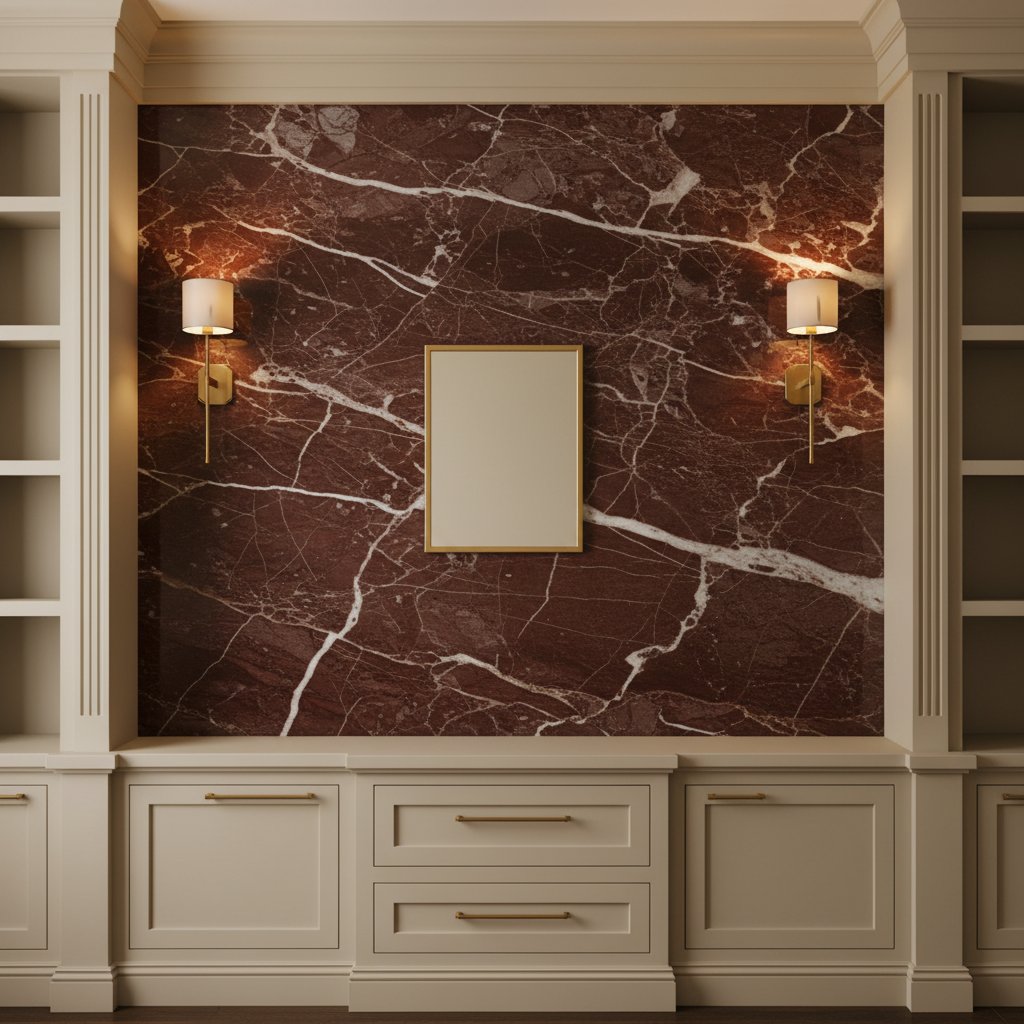
Rosso Levanto is quarried on the Italian Ligurian coast near the town of Levanto, in the hinterland of the Cinque Terre. The deposits are part of the larger ophiolite complex of the northern Apennines and are technically a serpentinite breccia rather than a true marble. The deep red colour comes from iron oxide mineralisation that bound and infilled the original fragmented serpentinite.
The white veining is calcite that crystallised through the rock during its complex tectonic history. The result is a stone with the durability of serpentine, the visual richness of a brecciated pattern, and a saturated red field that no other commercial stone reproduces.
- Origin: Levanto, Liguria, Italy
- Composition: Serpentinite breccia with calcite veining
- Tone: Deep red-burgundy
- Veining: Bright white flowing patterns
- Character: Confident, theatrical, warm
A Roman Stone
Rosso Levanto was quarried in the Roman era and used for inlays, columns, and decorative architectural elements across the empire. It was particularly favoured for floor inlays in important buildings because the red field paired with white marble produced one of the strongest colour contrasts available to ancient architects.
The quarry remained active during the Renaissance and continued through the modern era. Contemporary use focuses on residential interiors and luxury hospitality, where the stone is specified as a feature element in confident colour schemes.
Roman Inlay Floors to Contemporary Luxury Hotels
Rosso Levanto was quarried and worked by Roman builders, who used it in the inlay floors of the Forum at Rome, in private homes, and in public buildings where colour and permanence were desired. The saturated red field and bright white veining made it ideal for decorative compositions and border work. Roman builders valued it for its resistance to wear and its vibrant colour that held up under the traffic of public spaces.
Throughout the medieval and Renaissance periods, the stone appears in decorative inlay work and flooring in Italian churches and monasteries. The coastal town of Levanto in Liguria remained a quarrying and working centre for the material, supplying local and regional builders. The stone's association with the Italian coast gave it a particular status in maritime regions.
In contemporary luxury hospitality design, Rosso Levanto has gained traction as designers look for saturated red stones that read as refined rather than bombastic. High-end hotels, particularly in Mediterranean locations and in luxury resort properties, specify it for dramatic but controlled applications. The stone appears in spa and bathroom installations, in accent walls, and in feature elements where its depth and durability make a statement.
Among contemporary interior designers working in maximalist or post-modern vocabularies, Rosso Levanto is increasingly favoured for residential feature walls, fireplace surrounds, and kitchen islands. Its historical association with Roman and Mediterranean luxury aligns with designers interested in material tradition and historical reference. In Toronto's luxury residential market, it appeals to clients who want a bold colour statement grounded in historical authenticity and architectural confidence.
The Burgundy Field
Rosso Levanto reads as a deep red-burgundy field with bright white veining. The exact shade varies from slab to slab, ranging from a more orange-red to a darker wine-red. Selection matters significantly because two slabs from the same general block can produce noticeably different visual effects.
Under polished finish the stone catches light with a saturated, jewel-like quality. The veining flows in irregular patterns rather than running in linear bands, and the random orientation of the breccia fragments adds visual energy across the surface.
Polished, Honed, Leathered
Polished Rosso Levanto is the standard. The polish maximises the saturation of the red field and the contrast with the white veining. Honed Rosso Levanto reads softer and slightly more brick-toned, which can suit understated schemes. Leathered Rosso Levanto creates a beautiful tactile surface that adds visual depth without competing with the colour.
Living With Rosso Levanto
The serpentine breccia base of Rosso Levanto makes it more durable than typical calcite marbles and reasonably resistant to acid etching. The stone holds polish well and is suitable for kitchen, bathroom, and floor applications.
Sealing at installation and every three to four years thereafter is standard. The dark red field hides minor staining better than lighter stones, which makes Rosso Levanto a relatively forgiving feature stone for high-use applications.
What Goes With Rosso Levanto
Rosso Levanto pairs beautifully with cream-toned millwork, with rift-cut white oak, and with unlacquered brass. The saturated red works as a feature against quieter supporting materials. We avoid pairing the stone with other strong colours, which can compete and exhaust the eye.
For wall paint, soft creams, warm whites, and natural plasters all read beautifully against the red. Cool whites and greys fight against the warmth of the stone and should be avoided.