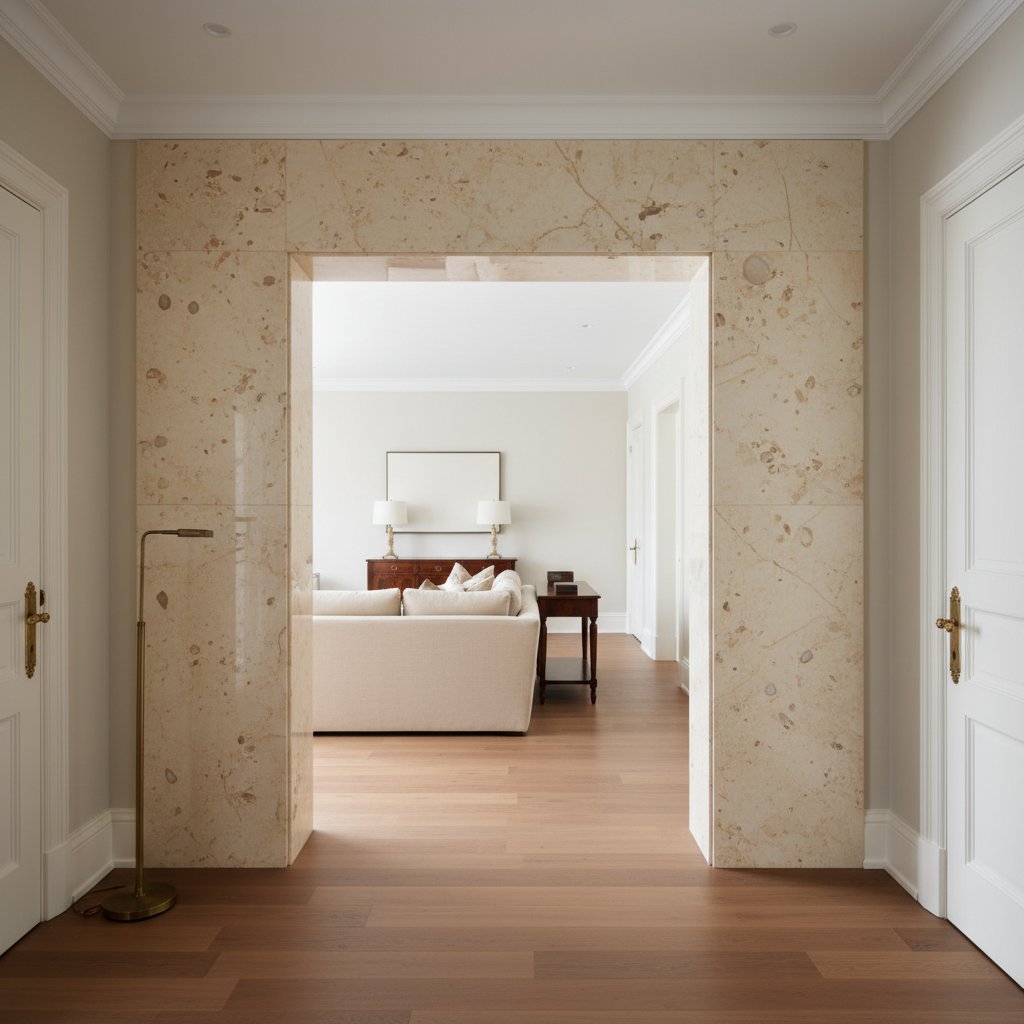
Andalusia and the Pinoso Quarries
Crema Marfil comes primarily from quarries near the town of Pinoso in the Alicante province of southeastern Spain, with related deposits across the Andalusia region. The deposits are technically a metamorphosed limestone rather than a fully recrystallised marble, which is why fossil inclusions remain visible in many slabs. They are part of the geological story.
The cream-beige tone comes from iron and clay impurities dispersed through the original limestone before metamorphism. Spanish stone industry classifies the material into several commercial grades based on tonal uniformity and inclusion density. The premium grade, Crema Marfil Coto, is the standard for high-end residential work.
- Origin: Pinoso, Alicante, Spain
- Composition: Metamorphosed limestone
- Tone: Warm cream-beige
- Veining: Subtle darker patterns with fossil inclusions
- Premium grade: Crema Marfil Coto
The Spanish Cream Tradition
Crema Marfil has been quarried since the late nineteenth century but became internationally significant only after the 1980s, when Spain's emergence as a major stone exporter brought the material to designers worldwide. It quickly displaced the Italian Botticino as the default cream marble for hotel and residential interiors because the colour reads warmer and the price point sits lower.
It is now ubiquitous in Mediterranean-influenced architecture. The colour pairs naturally with terracotta, white-painted millwork, and warm wood, which made it the marble of choice for the broader Mediterranean style of the 1990s and 2000s.
Spanish Royal Palaces to Modern Hospitality Standard
Crema Marfil has been quarried from Alicante province in Spain for centuries and appears in Spanish royal residences including the Palacio Real de La Granja and Palacio de Queluz in Portugal. The warm cream tone made it the natural choice for Mediterranean villas and institutional work where the palette ran warm. Its use across Spain's aristocratic estates established its association with Spanish luxury and warmth.
In the twentieth century, Crema Marfil became the standard specification for luxury hospitality globally. It appears in prestigious hotel chains across Europe, the Middle East, and North America, where its warm cream tone photographs beautifully under varied lighting and its restrained fossil-speckled pattern reads as refined rather than busy. The stone became almost synonymous with five-star hotel bathrooms and lobby flooring across the 1980s and 1990s.
Contemporary hospitality designers continue to favour Crema Marfil for its reliability and its compatibility with a broad range of design languages. It works as well in classical interiors as in transitional designs. Mediterranean resort architects favour it as a local expression of Spanish and Italian marble tradition. In residential practice, designers working with transitional or traditional design vocabularies favour it for its warmth and its ability to anchor spaces with existing warm-toned finishes.
In Toronto and across Canada, Crema Marfil has become the default choice for renovations of older homes and estates where the existing materials (oak floors, warm wood panelling, brass fixtures) establish a warm palette. It reads as the natural completion of that vocabulary. Among Canadian residential designers, it is one of the most-specified marbles precisely because it works so smoothly within established traditional design frameworks.
The Cream Field With Fossils
Crema Marfil reads as a warm cream surface with restrained darker veining. Most slabs show small fossil inclusions, which look like fine speckles or shell-shaped impressions in the field. These are diagnostic of the stone and part of its appeal. Designers who want a cleaner reading should specify the Coto grade, which has fewer visible inclusions.
Tonal variation between slabs is small but real. Two slabs from the same block can vary slightly in cream intensity. For visible installations we recommend selecting slabs in person and laying them out before fabrication.
Polished, Honed, Leathered
Polished Crema Marfil is the standard. The polish brings out the warm undertone and gives the stone a soft glow. Honed Crema Marfil reads quieter and slightly less warm, which suits transitional design schemes. Leathered Crema Marfil is uncommon but works well for floors and outdoor applications where slip resistance is important.
The stone takes a sharper polish than calcite Italian marbles do. The polished surface is durable and reflects light with a soft, characteristic warmth that polished cool whites cannot replicate.
Living With Crema Marfil
Crema Marfil is more durable than the typical Italian white marble. The metamorphic process was complete enough to produce a dense, less porous stone that handles daily use well. It is also somewhat resistant to acid etching, though not immune. For kitchen counters, bathroom vanities, and floor installations, Crema Marfil is among the most forgiving natural marbles available.
Sealing should be done at installation and refreshed every three to four years. The warm field hides minor staining and etching better than cool whites do.
What Goes With Crema Marfil
Crema Marfil pairs beautifully with warm woods (walnut, cherry, white oak in clear finish), with aged brass and bronze, with terracotta tile, and with hand-painted ceramic work in the Mediterranean tradition. Polished chrome and brushed nickel both read cold against the stone.
For wall paint, the stone reads at its best with warm whites, soft creams, and sage greens. Pure white walls fight against the cream undertone of the stone and should be avoided.