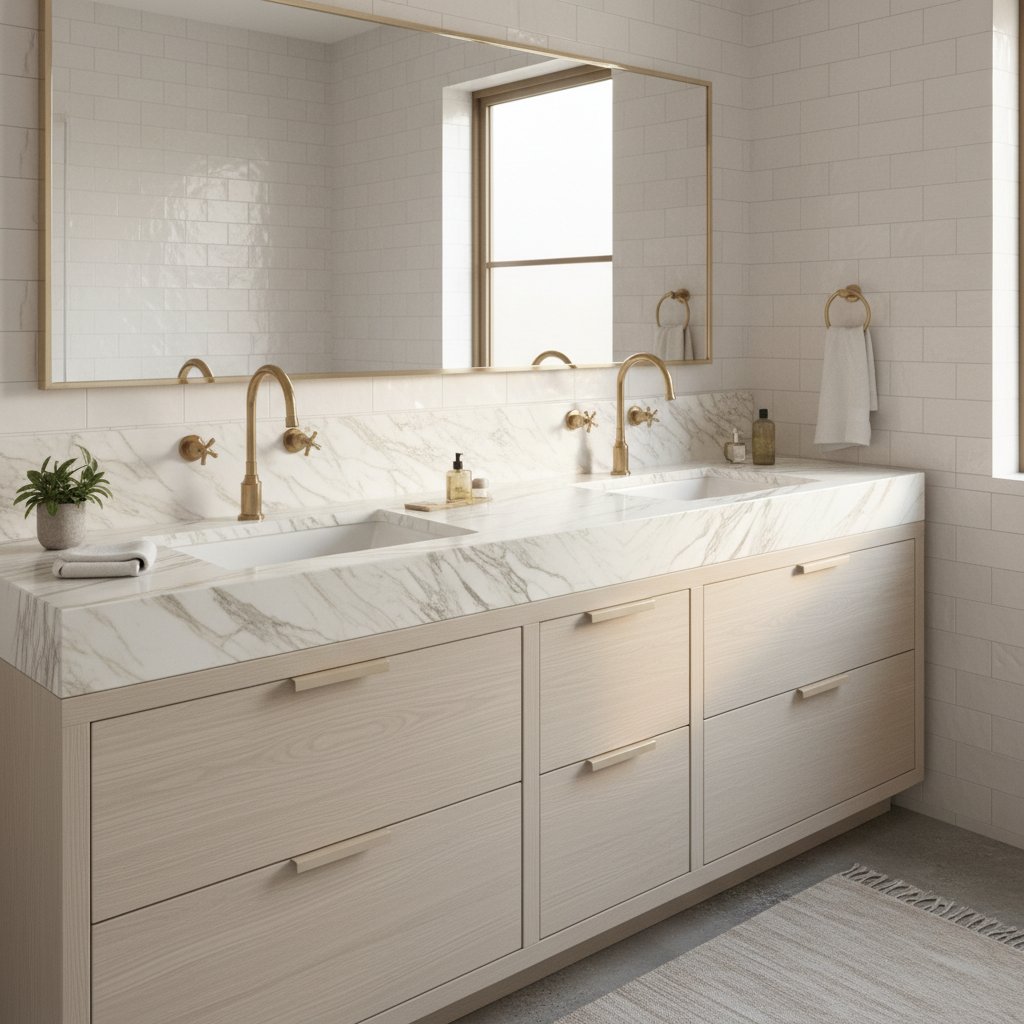
The Drama Region of Northern Greece
Volakas is quarried in the Drama region of northern Greece, near the village of Volakas itself. The deposits sit in the foothills of the Falakro mountains. The local marble industry has worked the area for more than a century, and the stone is now exported across Europe and North America.
Geologically, Volakas is a calcite marble that formed from limestone metamorphosed during regional tectonic events. The wispy grey-beige character comes from trace iron and clay minerals that were dispersed through the original limestone before metamorphism. The tectonic process stretched and folded the impurities into the soft feathered patterns the stone is known for.
- Origin: Drama region, northern Greece
- Composition: Calcite marble
- Tone: Warm white with cream undertone
- Veining: Soft grey-beige wispy patterns
- Character: Quiet, organic, never graphic
A Modern Greek Stone
Unlike Thassos or Pentelic, Volakas is not a stone of antiquity. The deposits were not commercially developed until the late nineteenth century, and the stone became internationally available only after Greek industrial expansion in the mid-twentieth century. This is part of why Volakas reads as a contemporary choice rather than a historical one.
It is now one of the most-specified Greek marbles for residential interiors and is regularly compared to Carrara and Bianco Lasa as a softer alternative to the Italian white tradition.
Royal Interiors and Contemporary European Design
Volakas has a subtle but consistent presence in Greek royal palaces and Ottoman-era estates across the Aegean. It was the white marble of choice for high-end residences in mainland Greece during the early-to-mid twentieth century, particularly for bathrooms and secondary spaces where a less dramatic stone than Thassos or Statuario was preferred. The stone's ability to shift tonality depending on light made it ideal for interior spaces where the quality of illumination varied.
In contemporary practice, Volakas appears frequently in the work of European luxury residential designers. The minimalist design movement in Scandinavia and Northern Europe has embraced it for its restraint and responsiveness to light. Contemporary architectural firms in Copenhagen, Stockholm, and Amsterdam favour Volakas for bathrooms and feature walls, particularly when working with mid-century modern or transitional design schemes. The stone pairs naturally with teak and walnut, making it the marble of choice for designers working within the Scandinavian tradition.
Tom Dixon and similar contemporary industrial-luxury designers have specified Volakas for hospitality projects where the emphasis is on understated material quality rather than visual drama. A number of luxury European hotel renovations over the past fifteen years have used Volakas for bathrooms and spa installations, drawn to its soft veining and its compatibility with both warm and cool tonal palettes. The stone is increasingly appearing in London townhouse renovations and in contemporary Mediterranean residential projects.
In Canada, a growing number of Toronto and Vancouver residential designers working in contemporary minimalism have discovered Volakas as a bridge between the cool clarity of Thassos and the warmth of softer stones like Crema Marfil. It reads as a sophisticated choice in transitional interiors where the emphasis is on material honesty rather than visual statement.
The Soft Field
Volakas reads as a soft, restful surface. The veining is present but never aggressive. Slabs vary in the density of the wispy markings, and we recommend visiting a slab yard to choose the specific cut for any visible installation, because two slabs from the same block can read quite differently.
The cream undertone of the field shifts depending on lighting. Under cool morning light Volakas reads almost neutral white. Under warm evening light or under brass-toned fixtures it reads distinctly cream. This responsiveness to light is part of its appeal.
Polished, Honed, Leathered
Polished Volakas reads brighter and more reflective. The wispy veining gains visual depth under polish. Honed Volakas reads quieter still, and the cream undertone becomes more pronounced. Leathered Volakas is uncommon but produces an interesting tactile surface that emphasises the soft organic character of the stone.
For most residential applications we recommend honed Volakas. The matte surface is more forgiving of etching, and the softer light reading suits the stone's natural character better than a high polish does.
Living With Volakas
Volakas is a calcite marble, which means it will etch on contact with acids. This is fine for bathrooms, fireplace surrounds, and feature walls. For kitchen counters, we walk clients through the etching question carefully and suggest honed finish for any client who wants the look but is concerned about appearance over time.
The stone takes sealer well. Standard sealing schedule is at installation and every two to three years thereafter. The cream undertone of Volakas hides minor staining better than a brilliant white like Thassos would.
What Goes With Volakas
Volakas is the white marble that pairs best with warm woods and aged metals. Unlacquered brass develops a patina that complements the cream undertone of the stone. Walnut, white oak, and warmer cherrywood all read beautifully against the field.
For tile pairings, Volakas works particularly well with hand-glazed zellige in cream or warm white, where the slight tonal variation in both materials produces a layered, lived-in reading. We avoid pairing Volakas with cool greys, which fight against the warmth of the stone.