The Tuscan Apennines
Pietra Serena is quarried in the Apennine mountains north of Florence, around the town of Firenzuola in the Mugello region. The deposits are sedimentary rather than metamorphic, which makes Pietra Serena technically a sandstone rather than a marble. The stone is fine-grained, dense, and worked easily with traditional masonry tools.
The blue-grey colour comes from clay and iron content in the original sediment. The stone formed during the Oligocene epoch, around thirty million years ago, when the Apennine basins accumulated thick layers of fine marine sediment that were subsequently lithified into the dense sandstone we see today.
- Origin: Firenzuola, Tuscany, Italy
- Composition: Fine-grained sandstone
- Tone: Soft blue-grey
- Texture: Fine uniform grain, minimal pattern
- Quarry age: Worked since the Roman era, prominent since the 15th century
The Stone of the Renaissance
Pietra Serena is the architectural stone of the Florentine Renaissance. Filippo Brunelleschi used it for the columns and pilasters of the Ospedale degli Innocenti and the Sagrestia Vecchia of San Lorenzo, where the soft blue-grey reads against white plaster walls in the colour scheme that defined Renaissance architecture. Michelangelo used Pietra Serena for the Laurentian Library and the Medici Chapel.
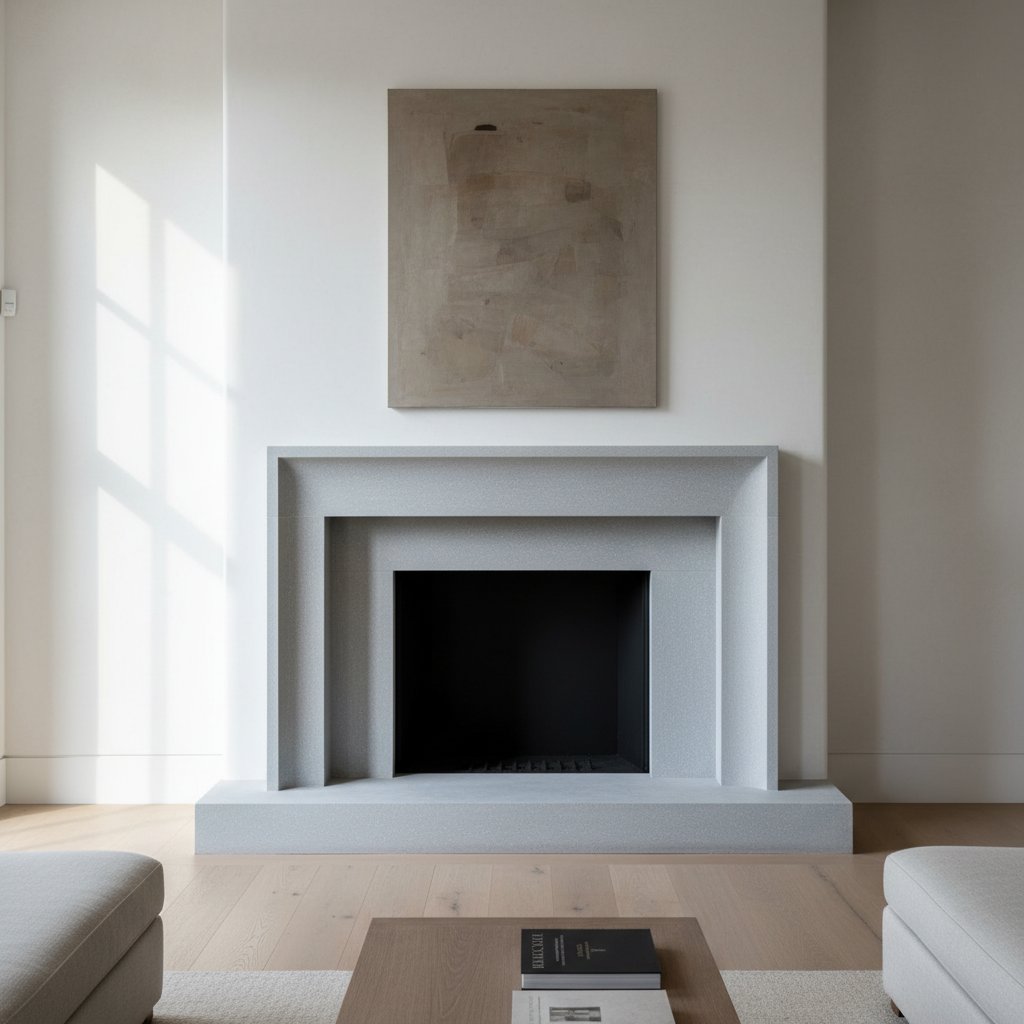
The Florentine convention of pairing Pietra Serena trim with white intonaco walls became a defining aesthetic of Renaissance and later Tuscan architecture. The stone was used for door surrounds, window frames, fireplace mantels, columns, capitals, and stair treads in essentially every important building in Florence from the 1420s onward.
The Stone of the Florentine Renaissance
Pietra Serena is quarried from the hills north of Florence and was used continuously by Florence's master builders from the thirteenth century onward. Brunelleschi specified it for the Ospedale degli Innocenti and the Sagrestia Vecchia. The stone's cool blue-grey tone and its workability made it ideal for the precise architectural vocabulary of early Renaissance design. The quiet colour read as refined restraint against the classical orders.
Michelangelo used Pietra Serena in the Laurentian Library and the Medici Chapel, where its serene field allowed the architecture and sculpture to remain the focus. The Pazzi Chapel, designed by Brunelleschi and completed by his successors, is essentially a study in Pietra Serena, where the stone becomes the primary vehicle for classical proportion and mathematical harmony. Few stones have shaped a single city's architectural identity as profoundly.
Through the fifteenth, sixteenth, and seventeenth centuries, Pietra Serena remained the stone of choice for domestic palazzos, churches, and civic buildings across Florence and Tuscany. Its association with Florentine Renaissance ideals of proportion, clarity, and intellectual refinement made it the reference stone for any architect working within that tradition. When neoclassical architects in the eighteenth and nineteenth centuries wanted to evoke Renaissance ideals, they reached for Pietra Serena.
In contemporary practice, Pietra Serena appears primarily in restoration work and in new construction that deliberately invokes Renaissance architectural language. Architects working in Tuscan vernacular, in historic preservation, or in contemporary classical design favour it for its historical authenticity and its timeless cool beauty. In North America, contemporary architects and designers use it in heritage renovations and in new work intended to reference European architectural tradition. The stone retains its association with intellectual and aesthetic refinement.
The Quiet Blue-Grey
Pietra Serena reads as a calm, uniform field. There is no veining and no dramatic pattern. The fine grain catches light evenly, and the blue-grey undertone shifts subtly with the surrounding lighting. Under cool morning light it reads as cool blue-grey. Under warm artificial light it reads as soft warm grey. The responsiveness to light is part of the stone's character.
Slabs vary in tone within a small range. Quarry blocks are graded for colour, and premium blocks are reserved for visible architectural elements. We work with a Tuscan supplier who provides selected stock for restoration and high-end residential work.
Traditional Finishes
Pietra Serena traditionally takes a hand-tooled or honed finish rather than a polish. Honed Pietra Serena is the standard for interior architectural elements and is what Renaissance masons produced with hand tools. Brushed or sandblasted Pietra Serena creates a slightly textured surface that suits exterior use and modern interior applications. A high polish is technically possible but reads as untraditional and is rarely specified.
Living With Pietra Serena
Pietra Serena is durable but porous. It will absorb stains if liquids are left to sit, and it should be sealed at installation and refreshed every two to three years. The stone is not vulnerable to acid etching the way calcite marbles are, which makes it suitable for kitchen applications.
For exterior use, Pietra Serena weathers well in Mediterranean climates. In the Toronto winter the stone survives but the surface should be sealed annually with a penetrating sealer formulated for sandstone. We are happy to discuss exterior applications case by case.
What Goes With Pietra Serena
The classical Florentine pairing is white plaster walls and Pietra Serena trim. This produces the colour scheme that defined Renaissance architecture and remains the most beautiful use of the stone. Beyond that, Pietra Serena pairs well with rift-cut white oak, with antique terracotta tile, and with iron and aged bronze hardware.
The stone reads beautifully against natural plaster, lime wash, and chalky paints. It fights against high-gloss surfaces and most synthetic materials. Pietra Serena is at its best in a room where most other materials are also natural.