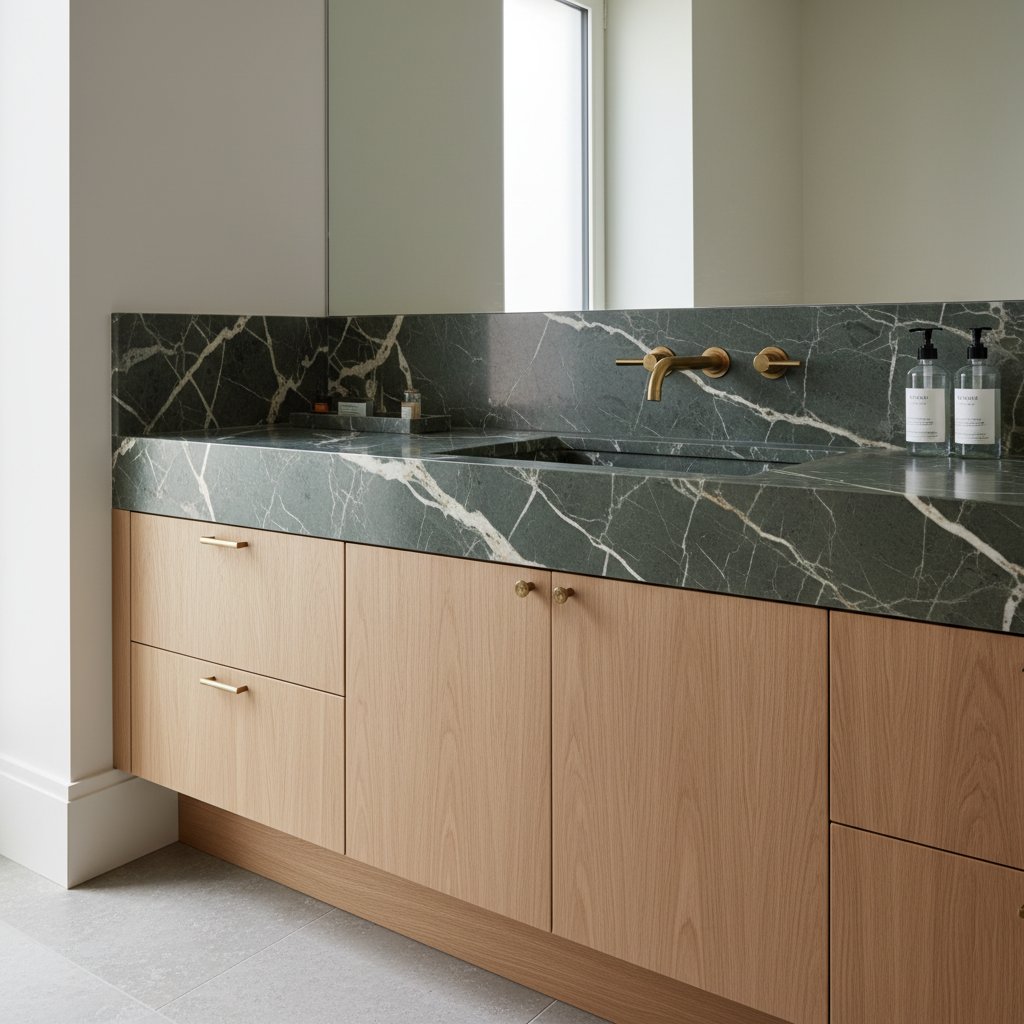
The Aosta Valley
Verde Alpi is quarried in the Aosta Valley in northwestern Italy, in the foothills of the Mont Blanc massif. The stone is a serpentinite, which is technically not a true marble but a metamorphic rock derived from peridotite or similar ultramafic source rock. The green colour comes from the magnesium iron silicate minerals (chrysotile, antigorite, and lizardite) that make up the bulk of the stone.
The white veining is calcite that crystallised along fault planes during the metamorphic process. The contrast between the deep green field and the bright white veining gives the stone its characteristic visual energy.
- Origin: Aosta Valley, northwestern Italy
- Composition: Serpentinite (metamorphic ultramafic rock)
- Tone: Mid-tone serpentine green
- Veining: Bright white calcite in flowing patterns
- Character: Mountain stone, jewel-like under light
The Italian Green Tradition
Italian green marbles have been used in architecture since Roman times. Verde Antico from Thessaly was prized in the Eastern Roman Empire, and Verde di Prato from Tuscany appears in the polychrome marble cladding of Florentine cathedrals. Verde Alpi entered the commercial market in the modern era and has been an important contemporary green stone since the early twentieth century.
The Italian rationalist movement used Verde Alpi alongside other Italian stones in the 1930s and 1940s. Today it appears in luxury residential interiors across Europe and increasingly in North American work.
Italian Rationalism to Contemporary Resort Architecture
Verde Alpi was rediscovered during the Italian Rationalist movement in the 1920s and 1930s. Modernist architects of that period were attracted to its bold colour as a statement against the traditional palette of whites and greys. It appears in institutional and public buildings from that era where the deep green read as a confident rejection of neoclassical restraint. The association with Italian modernism and with a particular moment of architectural daring became part of its identity.
In contemporary practice, Verde Alpi is most strongly associated with luxury hospitality design, particularly in resort environments. Aman resorts and similar ultra-luxury hospitality brands specify it for bathroom installations, spa environments, and feature walls where the bold colour reads as a statement of refined confidence. The stone appears in high-end hotels across Italy, Austria, and Switzerland, often in bathrooms and spa spaces where the deep green reads as a material expression of nature and luxury combined.
Contemporary residential architects working in modern Italian-influenced design favour Verde Alpi for kitchen islands and bathroom feature walls. Its bold colour and its historical association with Italian modernism align with the aesthetic of designers committed to contemporary classical or post-modern approaches. The stone reads as confident without being garish, particularly when paired with modernist joinery and contemporary lighting.
In Toronto and across Canada, Verde Alpi appeals to clients and designers willing to make a bold material statement. It appears in contemporary homes where the design vocabulary runs toward modern or where the existing architecture is simple enough to support a dramatic accent stone. The jewel-like quality of the polished green reads particularly well in master bathrooms and kitchen islands lit by strong directional light.
The Green Field
Verde Alpi reads as a deep green surface with bright white veining flowing across. The exact green tone varies from slab to slab, ranging from a darker forest green to a brighter olive-mid. Under polished finish the stone catches light in a way that gives it a jewel-like quality, particularly in rooms with directional lighting.
The veining is the most active feature of the stone. Some slabs carry heavy white veining that reads almost as a brecciated pattern, others are quieter with sparse veins. Selection matters more for Verde Alpi than for most marbles because the visual effect changes substantially with vein density.
Polished, Honed, Leathered
Polished Verde Alpi reads jewel-like and is the most common specification. The polish maximises the contrast between the deep green field and the bright white veining. Honed Verde Alpi reads softer and slightly more grey, which can be a better fit for understated schemes. Leathered Verde Alpi is uncommon but creates a beautiful matte surface for floors and exterior cladding.
Living With Verde Alpi
Serpentine marbles like Verde Alpi are denser and more durable than calcite marbles. They are also more resistant to acid etching, though not immune. The dense surface accepts polish well and holds it longer than the typical white Italian marble would.
Sealing should be done at installation and refreshed every three to four years. Verde Alpi is well-suited to kitchen use in addition to its more typical feature-wall and vanity applications.
What Goes With Verde Alpi
Verde Alpi pairs beautifully with warm woods (white oak, walnut), with unlacquered brass and aged bronze, and with cream-toned millwork. The deep green works particularly well as a feature surface against quieter supporting materials.
For tile pairings, the stone reads at its best with hand-glazed cream or warm-white zellige. We avoid pairing Verde Alpi with cool greys, which fight against the warm undertones in the green.