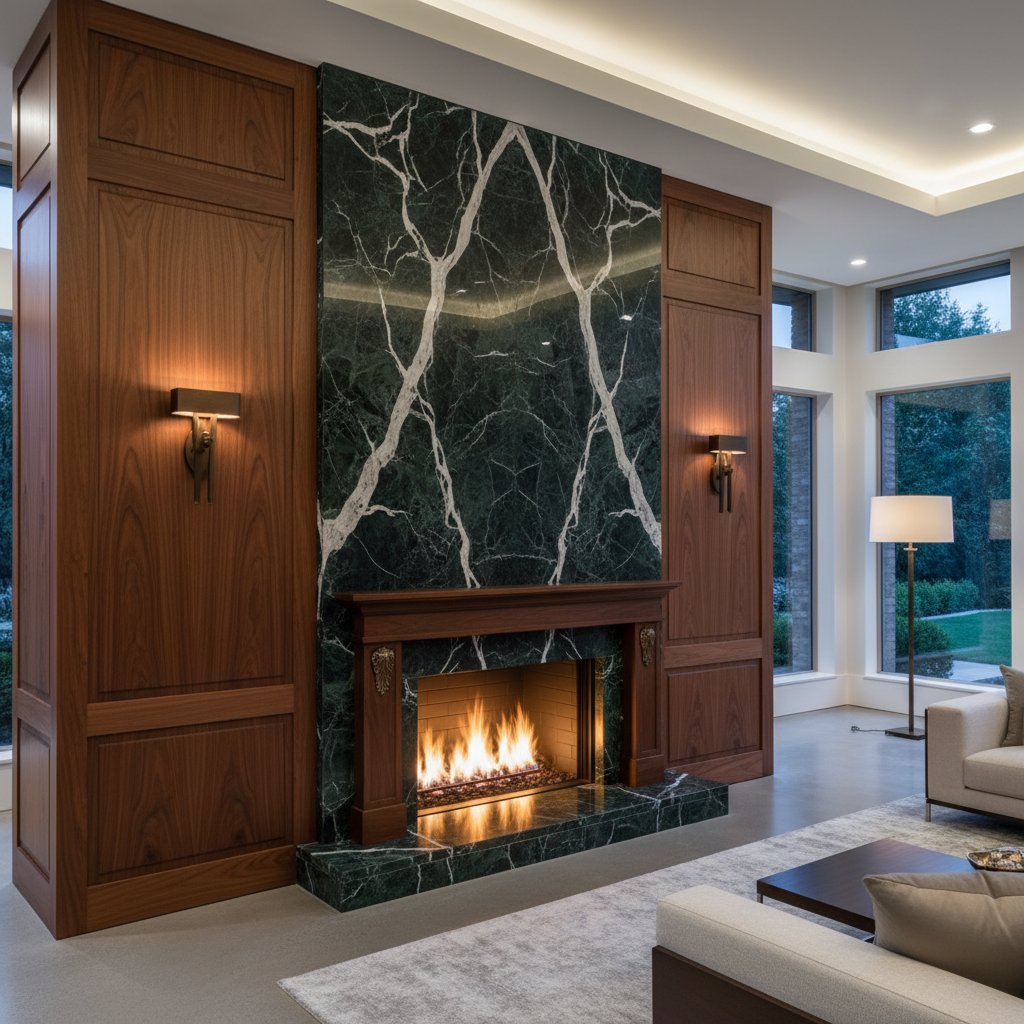
The Cycladic Island of Tinos
Verde Tinos is quarried on the island of Tinos in the Cyclades, Greece. The deposits sit in the central mountains of the island. Like Verde Alpi, Verde Tinos is a serpentinite rather than a true marble. The deep green colour comes from chrysotile, antigorite, and lizardite minerals, with the depth of tone reflecting a higher iron content than the Italian Alpine stones.
The white veining is calcite that crystallised in fault systems during the metamorphic history of the rock. The contrast between the dark green field and the bright white veins is what gives the stone its characteristic visual rhythm.
- Origin: Tinos, Cyclades, Greece
- Composition: Serpentinite
- Tone: Deep forest green
- Veining: Bright white in flowing patterns
- Quarry age: Worked since the classical period
A Classical Stone
Verde Tinos has been quarried since at least the classical Greek period. Tinos is best known historically for its sculptural marble tradition (the island produced many of Greece's great sculptors of the eighteenth and nineteenth centuries), and Verde Tinos was used alongside the white sculptural marbles for inlays, columns, and decorative elements.
The stone has been continuously quarried in modest volumes throughout the modern era. It is exported across Europe and increasingly to North America for residential and high-end commercial applications.
Greek Sculptural Tradition to Contemporary Diaspora Architecture
Verde Tinos comes from the island of Tinos in the Cyclades, where it has been worked into sculptural and architectural elements since antiquity. The island has a long tradition of marble working and stone carving; Tinos marble workers are regarded as master craftspeople across the Mediterranean. The stone was traditionally used for religious sculpture and ecclesiastical architecture because its deep green was believed to carry spiritual significance in Orthodox tradition.
The stone appears in Orthodox churches and monasteries across Greece and in diaspora communities worldwide, where it continues to be specified for religious spaces. Its association with Greek Orthodox tradition and with Aegean island craft made it a natural choice for communities maintaining cultural and spiritual connection to Greece. Church interiors and religious sculptures in diaspora communities across North America, Australia, and Europe often feature Verde Tinos.
In contemporary residential architecture, Verde Tinos has gained traction among designers attracted to its depth and its responsiveness to light. Unlike the brighter Italian greens, its deep tone reads as grounding and serious rather than as display. Contemporary Greek architects and internationally practicing designers with connections to Greece have championed it in high-end residential work. The stone appears in luxury homes across Europe and in diaspora residences in North America where cultural identity and material authenticity matter.
In Toronto's residential market, Verde Tinos appeals to clients and designers who want a green feature stone with gravitas and depth. It works particularly well in homes with existing warm-toned woods and brass finishes, where the deep green reads as a natural complement rather than a contrast. Among designers working in contemporary classical or transitional modern styles, it represents a more grounded alternative to lighter, brighter greens.
The Deep Green Field
Verde Tinos reads as deep, almost moody green under most lighting. Under direct light it lifts to read jewel-like. Under softer ambient light it reads almost black-green. This responsiveness to light makes the stone particularly interesting in rooms with varied lighting conditions.
The veining is bright white and reads as a strong contrasting element against the dark field. Slabs vary in vein density. We strongly recommend slab selection in person for any visible installation.
Polished, Honed, Leathered
Polished Verde Tinos is the standard. The polish brings out the depth of the green and maximises the contrast with the white veining. Honed Verde Tinos reads quieter and slightly more grey-green, which works well in restrained schemes. Leathered Verde Tinos creates a beautiful matte texture that suits floor and exterior applications.
Living With Verde Tinos
Serpentine stones like Verde Tinos are dense and durable. They handle daily use well and resist acid etching better than calcite marbles. They are well-suited to kitchen counters, bathroom vanities, and floor applications.
Sealing at installation and every three to four years thereafter is standard. The dark green field hides minor staining better than lighter stones.
What Goes With Verde Tinos
Verde Tinos pairs beautifully with rich woods (walnut, mahogany, cherry) and with warm metals (unlacquered brass, antique brass, aged bronze). The deep green provides a grounding base for warmer supporting materials.
For wall paint, soft creams and natural plasters read warm against the green. Cool whites can read cold and should be avoided. The stone also works well in monochromatic green schemes where it serves as the deepest tone in a layered palette.